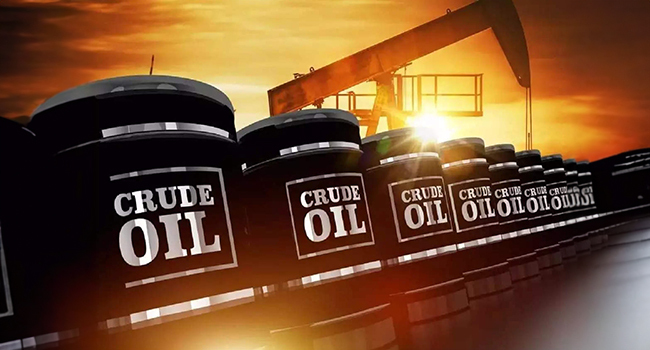
Global oil prices continued their upward rally on Tuesday while major stock markets extended losses after fresh United States airstrikes against Iran intensified tensions in the Middle East, raising concerns over the collapse of an already fragile ceasefire and the possibility of renewed inflationary pressure.
Technology stocks remained under significant pressure, with South Korea’s benchmark Kospi index extending its recent decline as chipmaker SK hynix suffered another sharp selloff amid mounting concerns that enthusiasm surrounding artificial intelligence investments may be fading.
The latest escalation followed Iran’s missile attack on a commercial vessel navigating the Strait of Hormuz early Sunday before Tehran announced the closure of the strategic waterway, through which nearly one-fifth of the world’s oil supply is transported.
The development prompted a fresh round of US military strikes targeting Iranian positions, while Tehran retaliated by launching attacks against locations in Bahrain, Jordan, Kuwait and Oman.
Ahead of the latest military operation, President Donald Trump had signalled a tougher response during an interview with conservative radio host Hugh Hewitt on Monday.
“We’re going to hit them very hard tonight, and we’re going to hit them hard tomorrow,” Trump said.
The US president later announced on his Truth Social platform that the United States would become “THE GUARDIAN OF THE HORMUZ STRAIT” and impose a 20 per cent charge on all cargo transported through the critical maritime corridor.
Trump explained that while Iranian ports would once again face a blockade, other nations would continue to enjoy unrestricted access to the shipping route.
“…all other countries will have fair and open use of the strait,” he stated.
Despite the renewed military confrontation, Trump maintained that diplomatic efforts with Tehran had not completely collapsed.
“Yeah, I think a deal is possible. Sure, I do,” he told reporters at the White House.
“We had a deal with them two days ago and then they said ‘Oh we can’t make that deal. We have to negotiate it further.’”
Crude oil prices had already surged by more than nine per cent on Monday as investors reacted to fears that prolonged conflict could disrupt global energy supplies and trigger another wave of inflation capable of forcing major central banks, including the US Federal Reserve, to tighten monetary policy.
Prices continued to rise on Tuesday, adding more than one per cent in early trading.
Commenting on the proposed shipping levy, Bank of New Zealand strategist Jason Wong questioned both its practicality and legality.
“With Trump, one never quite knows how seriously to take such pronouncements, but Gulf allies would not be pleased with this plan, and it almost certainly violates international law,” Wong said.
He estimated that the proposed 20 per cent levy would increase shipping costs by approximately 16 dollars for every barrel of crude transported through the Strait of Hormuz on a standard supertanker.
“It remains to be seen whether the plan will stick — probably not — and whether it is merely a negotiating tactic aimed at getting Iran to pause its military strikes on shipping in the area,” he added.
The renewed geopolitical uncertainty also weighed heavily on global equity markets, extending the recent retreat from technology stocks as investors reassessed lofty valuations driven by the artificial intelligence boom.
South Korea’s market remained among the worst performers, with SK hynix falling by more than three per cent after suffering a 15 per cent slump a day earlier. Its shares listed in New York also dropped by more than nine per cent after initially surging over 13 per cent during their market debut last Friday.
Major markets across Tokyo, Hong Kong, Sydney, Singapore, Taipei, Wellington, Manila and Jakarta also closed lower as investors adopted a cautious approach.
Market participants are now preparing for a busy week that includes the start of the corporate earnings season, testimony before the US Congress by Federal Reserve Chairman Kevin Warsh and the release of the latest US inflation figures.
Adding to concerns over monetary policy, Federal Reserve Governor Christopher Waller warned that persistently high inflation could necessitate an earlier-than-expected interest rate increase.
“If we get another hot reading on core inflation this week, then the (rate-setting committee) will need to consider tightening monetary policy in the near term,” Waller said on Monday.
Key Figures Around 0230 GMT
West Texas Intermediate: UP 1.3 per cent at $79.15 a barrel
Brent North Sea Crude: UP 0.7 per cent at $83.91 a barrel
Tokyo – Nikkei 225: DOWN 0.8 per cent at 66,678.36 (break)
Seoul – Kospi: DOWN 2.6 per cent at 6,631.83
Hong Kong – Hang Seng Index: DOWN 0.2 per cent at 24,166.38
Shanghai – Composite: FLAT per cent at 3,912.31
Euro/dollar: UP at $1.1394 from $1.1384 on Monday
Pound/dollar: UP at $1.3358 from $1.3353
Dollar/yen: DOWN at 162.35 yen from 162.43 yen
Euro/pound: UP at 85.30 pence from 85.25 pence
New York – Dow: DOWN 0.3 per cent at 52,498.64 (close)
London – FTSE 100: FLAT at 10,498.29 (close)