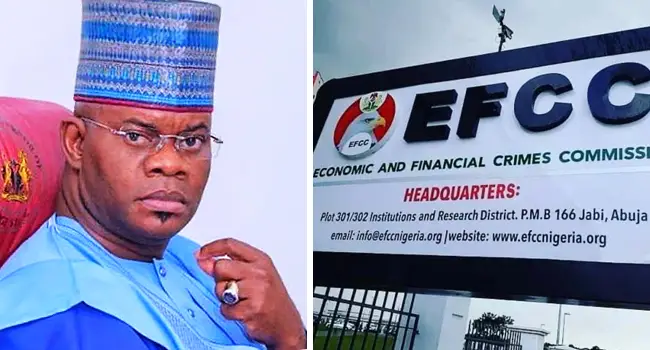
Witness of the Economic and Financial Crimes Commission, EFCC, in the alleged money laundering trial of former Governor Yahaya Bello of Kogi State, Mshelia Arhyel Bata yesterday re-affirmed that fund withdrawals by the state government did not breach any banking law.
Bata stated this while being cross-examined by the former governor’s counsel, Joseph Daudu (SAN) before Justice Emeka Nwite of the Federal High Court in Abuja.
He also admitted that Bello’s name did not appear as beneficiary in the account statements presented as evidence in court.
Bata, a compliance officer with Zenith Bank, testified as the fourth Prosecution Witness, PW-4.
The prosecution had concentrated on withdrawals by Abdulsalam Hudu.
Under cross-examination, Daudu drew the witness attention to certain withdrawals by Umar Comfort Olufunke, which he said the prosecution did not mention while being led in evidence-in-chief.
PW-4 told the court that Olufunke’s withdrawals, in multiples of N10 million, were between December 2017 and April 2018, with beneficiaries being various hotels in Kogi.
The witness also confirmed withdrawals by Alhassan Omakoji between November 2021 and December 2022, which he admitted, did not exceed N10 million per withdrawal.
He said the withdrawals were in line with the limits set by the Central Bank of Nigeria, CBN.
He equally admitted that he was not aware of any law that regulates how Kogi government spends its money or allocation.
“Confirm as compliant officer that when multiples of cheques of N10 million are presented, the customers are merely adhering to the withdrawal limits set by the CBN?” Daudu asked?
“Yes my lord, the N10 million on the cheque is the maximum allowed threshold on cash withdrawal set by CBN,” he said.
When asked if Bello’s name appeared as beneficiary on Exhibit 22 which he (Daudu) and lawyer to the prosecution, Kemi Pinheiro, SAN, had taken him through, Bata said: “No, my lord, the name, Yahaya Bello, does not appear as beneficiary.”
When asked if there is any law that regulates how the state government spends its money, the witness said: “I am not aware of any law that regulates how Kogi State government spends its money or allocation in its account.”
He said apart from the beneficiaries like the hotels mentioned in the account statements, there was no way he could know what the state’s transactions were meant for.
Justice Nwite then discharged the witness after Pinheiro informed that there was no re-examination.
The witness had, at the last hearing, confirmed that the former governor was neither a signatory to nor connected with any of the accounts presented as evidence.
He admitted that going through Exhibit 22A, from pages 24 to 413, Bello was not also listed on any of the documents as a beneficiary of any transaction.
The anti-graft agency also called its fifth Prosecution Witness, PW-5, Jesutoni Akoni, a compliance officer with Ecobank Plc, who was led in evidence by another prosecution counsel, Chukwudi Enebeli (SAN).
The witness tendered a summon letter written to Ecobank, which was admitted in evidence.
The EFCC lawyer also sought to tender the statement of account of Moses Ailetu companies with certificate of identification, from January 1 to 31, 2016.
Daudu did not oppose it and it was admitted as exhibit.
Enebeli told the witness to identify the different columns in the statement, which he did.
He was told to confirm cash deposits by the company, which were between N3 million and N20 million, and totalling N57 million.
Akoni, while being cross-examined by Daudu, equally confirmed that former Governor Bello was not a beneficiary of the said deposits.
“Confirm that any of the deposits you identified carries the name of Yahaya Bello,” Daudu asked.
“None of them carries the name, Yahaya Bello,” she said.
Akoni also admitted that it was not possible to discern the source of funds from the face of the documents.
The prosecution, thereafter, introduced its PW-6, Mohammed Hassan, who was also on subpoena from Keystone Bank.
Hassan, a relationship officer with the bank, was asked to produce the statements of account of Dantata and Sawoe Construction Company.
The documents were tendered as exhibit, along with the certificate of identification, after the defence lawyer did not oppose.
After the PW-6 was cross-examined, the EFCC called its PW-7, Olomotame Egoro, a compliance officer on subpoena from Access Bank.
Led in evidence by Pinheiro, he confirmed to the court that he had 12 sets of documents that had been requested.
“We supplied sufficient customer’s details that were extracted from the account opening packages at the time the customer opened the account,” he said.
The defence counsel did not object to the admission of the account statements proper, but opposed other documents attached which he regarded as irrelevant to what the prosecution requested.
“I am not going to object to the account proper, but I will object to the 12 purported extractions from the account opening documents attached.
“But I will not object to the statements of account, which were subpoenaed,” Daudu stated.
The senior lawyer prayed the court to direct the prosecution to remove “all the extraneous documents attached,” and the prosecution team detached those regarded as irrelevant.
Justice Nwite subsequently adjourned the matter until Novernor 11 for continuation of trial.