

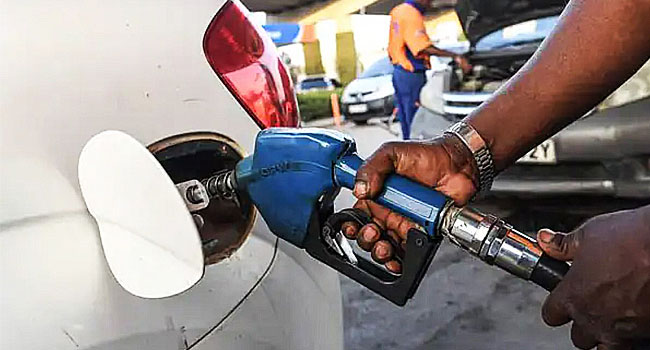
…Soaring fuel costs deepen pressure on households, businesses in Abuja
… Crude oil price hits $112 per barrel
By Charles Ebi
Nigeria’s rising fuel prices continued to weigh heavily on households and businesses in February 2026, with total spending on Premium Motor Spirit ,PMS, popularly known as petrol, estimated at N1.47tn for the month alone.
Data obtained from the Nigerian Midstream and Downstream Petroleum Regulatory Authority showed that Nigerians consumed about 1.593 billion litres of petrol in February, highlighting sustained demand despite the higher pump price regime.
At an average price of N920 per litre, the cost of fuel consumption surged significantly, reflecting the growing financial burden on consumers following the removal of petrol subsidy and the shift toward market-driven pricing.
A breakdown of the figures indicates that average daily petrol consumption stood at 56.9 million litres during the 28-day period.
While slightly lower than January levels, the volume remains substantial, underscoring the continued dependence on petrol across key sectors of the economy.
Analysts say the persistent demand reflects structural realities within Nigeria’s energy landscape, where petrol remains a primary source of power for transportation, electricity generation and small-scale business operations.
In the same vein, Prices of food items, goods, and services have surged across markets in Nigeria’s Federal Capital Territory, as rising fuel costs linked to the Middle East crisis continue to ripple through the economy.
A market survey conducted in Abuja shows that the increase in the pump price of petroleum products has significantly raised transportation and production costs, forcing traders to adjust prices upward.
The development is placing pressure on households, with many residents reporting higher spending on food and basic services amid tightening incomes.
At the Orange Market along the Abuja-Keffi road, a major bulk food hub, the price of a big basket of tomatoes has jumped from between N9,000 and N10,000 in February to as high as N35,000.
A large bag of onions now sells for between N40,000 and N45,000, up from N15,000 to N25,000.
In Lugbe market, a basket of sweet potatoes has doubled to between N2,000 and N2,500, while five tubers of yam now cost as much as N10,000.
The price of beans has also risen sharply, with white beans now selling for up to N1,600 per mudu.
Similar trends were observed in Orozo and Karu markets, where yams, tomatoes, peppers, and onions have recorded significant increases.
In Wuse and Utako markets, traders also reported higher prices across staple food items, although Garki Modern Market showed mixed movements, with slight reductions in some items like tomatoes.
Beyond food, the rising cost of fuel and unreliable electricity supply are pushing up the prices of essential goods and services.
Producers and small business owners say they are increasingly reliant on diesel and petrol to power operations, further raising operating costs.
A sachet water distributor in Abuja said the price of a bag of water has risen from about N300 to as high as N500 due to increased diesel expenses and poor electricity supply. He noted that production has been constrained despite strong demand driven by the hot season.
Similarly, an ice block seller reported raising prices from N500 to N800 as fuel and generator costs continue to climb, warning that the situation is affecting her ability to meet customer demand.
Residents say the impact is being felt beyond food, extending to everyday services. A parent in Apo said the cost of children’s haircuts has more than doubled within weeks, reflecting the broader inflationary pressure across the economy.
Others expressed concern over the rising cost of basic necessities such as water, with some warning that further increases could push essential goods beyond the reach of low-income households.
A single mother of three noted that her standard of living has declined steadily, calling on the government to address the rising cost of transportation and energy, which she said are key drivers of the current price surge.
Traders and business owners are urging the Federal Government to take urgent steps to stabilise fuel prices and improve electricity supply, noting that these are critical to easing inflationary pressures.
A yam seller at Nyanya market said transportation costs for moving produce from Benue State to Abuja have tripled, significantly affecting retail prices.
Business operators also warned that without intervention, rising input costs could further constrain supply, deepen inflation, and weaken consumer purchasing power in the coming months.
On the back of the ongoing U.S.-Israel-Iran war, crude oil prices have surged above $100 in the global oil market, pushing the price of petrol to above N1,000 in Nigeria.
“The reliance on petrol is still very high, and until there is a reliable alternative, consumers will continue to bear the brunt of rising prices”, the Registrar of the Institute of Finance and Control, Godwin Eohoi said. “What we are seeing is a direct transmission of fuel costs into broader economic hardship”.
Beyond consumption, the February data also points to shifting trends in Nigeria’s domestic fuel supply chain, particularly with the growing role of private refining.
Supply from the Dangote Petroleum Refinery averaged about 36.5 million litres per day during the month, a decline from the previous month’s levels.
Overall domestic petrol supply also dropped significantly to around 39.6 million litres per day, reflecting ongoing adjustments in the market.
Industry observers attribute the decline to a mix of factors, including supply realignments, fluctuating import volumes and pricing dynamics in the downstream sector.
Meanwhile, Nigeria’s state-owned refineries remained inactive in terms of petrol production throughout February. Facilities in Port Harcourt, Kaduna and Warri did not record any petrol output as rehabilitation and upgrade works continued.
The lack of output from these refineries continues to underscore Nigeria’s reliance on private refining capacity and imported petroleum products to meet domestic demand.
Although there was no petrol production, some of the refineries continued to release previously refined diesel stocks into the market at minimal volumes, indicating partial operational activity.
While the government’s ongoing reforms including subsidy removal and increased support for domestic refining are aimed at improving long-term efficiency, the immediate impact has been higher costs for consumers.
They argue that accelerating the rehabilitation of state-owned refineries and scaling up operations at private facilities will be critical to easing supply constraints and stabilizing prices.
Meanwhile, crude oil prices have surged to above $112 per barrel as the Iran-United States-Israel war escalation entered day 22 on Sunday amid a surge in domestic petrol prices in Nigeria.
Findings showed that Brent crude rose by 3.26% on a day-to-day basis to $112.2 per barrel, and West Texas Intermediate crude blend increased by 2.80% to $98.23 per barrel as of filing the report.
The crude oil price upsurge comes as the US, Israel, and Iran have not been able to agree on a ceasefire deal.
U.S. President Donald Trump has issued a 48-hour ultimatum demanding that Tehran fully reopen the Strait of Hormuz to unrestricted commercial shipping or face targeted U.S. strikes on its power infrastructure.
In a post shared early Sunday morning on his Truth Social, Trump declared: “If Iran doesn’t fully open, without threat, the Strait of Hormuz, within 48 hours from this exact point in time, the United States of America will hit and obliterate their various power plants starting with the biggest one first”.
The ultimatum comes amid a three-week-long conflict that began on February 28, with Operation Epic Fury, a U.S.-Israeli offensive aimed at dismantling Iran’s nuclear program, ballistic missile capabilities, naval assets, and regional proxy networks.