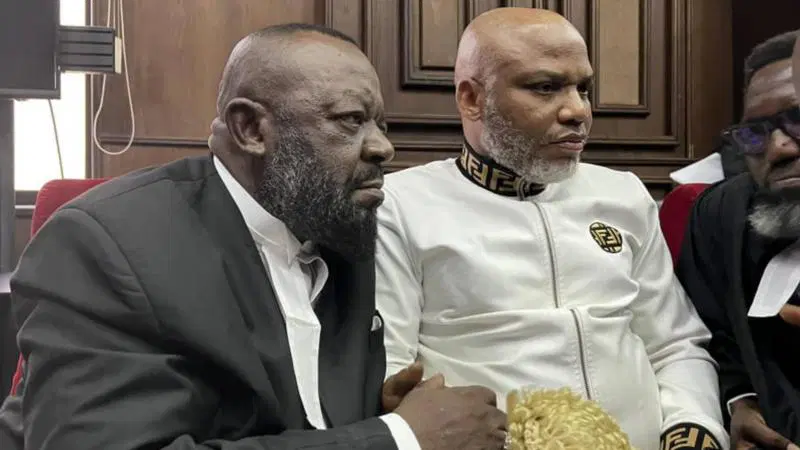
Lead counsel to the detained leader of the Indigenous People of Biafra (IPOB), Nnamdi Kanu, Aloy Ejimakor, has expressed reservations about certain aspects of the ongoing court proceedings involving his client, particularly the amount of time granted to the defence team to present its case.
In a statement issued on Saturday, Ejimakor said the defence was allotted a relatively short period to commence its case after the prosecution concluded its presentation in June 2025. According to him, the prosecution wrapped up its case after calling five witnesses since the trial resumed in March.
The lawyer explained that following the court’s rejection of a no-case submission filed by the defence, six hearing days were subsequently scheduled for Kanu’s team to open its defence.
Ejimakor stated that after consulting with members of his legal team, Kanu expressed a desire to personally conduct parts of his defence and requested additional time to adequately prepare and arrange witnesses. However, he claimed that the request for more preparation time was not approved by the court.
He argued that there appeared to be an imbalance between the amount of time available to the prosecution and that provided to the defence, stressing that effective legal representation requires sufficient opportunity to prepare evidence, organize witnesses, and develop legal arguments.
According to the senior lawyer, the defence believes adequate preparation time is a critical component of a fair hearing and should not be restricted in a manner that could affect the presentation of a case.
Ejimakor cited Sections 36(6)(b) and 36(6)(c) of the 1999 Constitution of the Federal Republic of Nigeria, which guarantee an accused person the right to adequate time and facilities for the preparation of a defence, as well as the option to defend himself personally or through legal counsel of his choice.
He further noted that questions relating to the court’s jurisdiction had been raised during the proceedings and, in his view, remained unresolved before subsequent stages of the trial were allowed to continue.
The lawyer maintained that jurisdictional issues are fundamental legal questions that ordinarily require determination before substantive proceedings move forward. He suggested that addressing such matters first would help ensure procedural clarity and compliance with established legal principles.
Ejimakor also stated that the defence team found it difficult to proceed effectively within the current schedule and reiterated the need for the court process to align with constitutional safeguards and internationally recognized fair trial standards.
While emphasizing that the defence remains committed to participating in the proceedings, he insisted that adequate time, proper facilities, and full respect for due process are necessary to guarantee justice and public confidence in the judicial process.
The IPOB leader has remained at the center of a long-running legal battle that has generated widespread public interest and debate across Nigeria. His legal team continues to argue that all constitutional protections afforded to defendants should be fully observed throughout the proceedings.
Ejimakor concluded by stressing that adherence to due process and fair hearing principles remains essential in ensuring that justice is not only done but is also seen to be done in a case of such national significance.