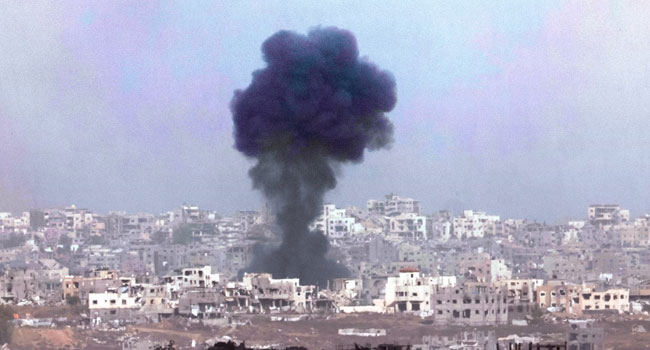
Iran on Sunday carried out a third consecutive day of retaliatory military strikes against United States targets, accusing Washington of breaching a fragile ceasefire agreement, while the US also blamed Tehran for repeated violations, raising fresh concerns over the future of peace negotiations aimed at ending the Middle East conflict.
The latest exchanges have heightened tensions surrounding the Pakistan-brokered peace initiative intended to end a war that began in February after coordinated military operations by the United States and Israel against Iranian territory.
The conflict has significantly disrupted maritime activities in the Strait of Hormuz, one of the world’s most strategic shipping routes, while also triggering instability in global energy markets.
Iran’s Revolutionary Guards announced on Sunday that they had intensified security measures across the Strait of Hormuz and warned that any vessel violating regulations governing passage through the waterway would face tougher action.
According to the Guards, only the officially designated shipping corridor running along Iran’s coastline would be recognised for safe navigation.
The military also claimed responsibility for fresh retaliatory attacks targeting American military facilities in Kuwait and Bahrain.
In a statement, the Revolutionary Guards alleged that eight major US military installations, including the Ali al-Salem Air Base in Kuwait and the US Fifth Fleet naval headquarters at Port Salman in Bahrain, were struck during the operation.
The statement warned that any future military action by the United States, regardless of its scale or justification, would attract what it described as a crushing response.
“Any enemy aggression, whatever the pretext, even against insignificant targets, will have a crushing response,” the statement read.
Authorities in Bahrain confirmed that air raid sirens sounded twice across parts of the Gulf kingdom on Sunday following reports of the attacks.
The renewed violence comes despite a memorandum of understanding brokered by Pakistan in mid-June, under which both the United States and Iran agreed to refrain from initiating military operations against one another.
The agreement committed both countries and their allies to avoid the threat or use of force while negotiations toward a lasting peace continued.
Despite the ceasefire, hostilities have continued to escalate.
US President Donald Trump warned on Saturday that Iran would “no longer exist” if Washington was forced to resume full-scale military operations.
The warning followed another round of US airstrikes targeting Iranian military infrastructure.
Posting on his Truth Social platform, Trump said American aircraft had struck missile and drone storage facilities as well as coastal radar installations after accusing Iran of violating the ceasefire agreement once again.
“There may come a point when we are no longer able to be reasonable, and will be forced to militarily complete the job that we very successfully started. If that happens, the Islamic Republic of Iran will no longer exist!” Trump stated.
The United States Central Command confirmed that Saturday’s strikes were launched in response to an alleged Iranian drone attack on the Panama-flagged oil tanker Kiku, which was transporting approximately two million barrels of crude oil through the Strait of Hormuz.
According to CENTCOM, the military operation targeted Iranian surveillance infrastructure, communication facilities, air defence systems, drone storage locations and naval mine-laying capabilities.
Iranian media reported explosions in the southern regions of Sirik and Qeshm shortly after the strikes.
The latest US operation followed similar attacks carried out on Friday, which Washington said were launched after another commercial vessel, the Ever Lovely, came under attack.
Meanwhile, tensions have also escalated along Israel’s northern frontier with Lebanon.
Israel carried out fresh military strikes after Hezbollah leader Naim Qassem rejected a US-backed agreement designed to end hostilities between Israel and Lebanon.
Iran condemned the latest American attacks, describing them as a blatant violation of the temporary ceasefire agreement.
Although Tehran previously agreed to guarantee safe commercial navigation through the Strait of Hormuz for 60 days under the memorandum of understanding, authorities have continued warning vessels against using routes not authorised by Iran.
Despite the military tensions, commercial shipping has continued through the strategic waterway, although some vessels have reportedly chosen routes outside the designated Iranian corridor.
Security analysts believe Tehran is likely to continue applying limited military pressure around the Strait without triggering a wider regional conflict.
H.A. Hellyer of the Royal United Services Institute in London said Iran could maintain controlled pressure on international shipping to strengthen its negotiating position while avoiding direct escalation into another full-scale war.
He noted that upcoming US congressional elections could increase pressure on Washington to secure a diplomatic breakthrough sooner rather than later.
At the same time, developments in Lebanon continue to complicate the broader peace process.
The Lebanese front became active in early March after Hezbollah launched rocket attacks against Israel in support of Iran, prompting an Israeli military response and a prolonged exchange of hostilities.
Although Israel and Lebanon signed a US-supported framework agreement on Friday aimed at achieving long-term peace, Hezbollah rejected the proposal the following day.
Hezbollah leader Naim Qassem described the agreement as humiliating and insisted that any settlement in Lebanon should instead be addressed within the wider US-Iran peace negotiations.
Israel, however, has maintained that its forces will remain inside the security zone in southern Lebanon until Hezbollah is fully disarmed.
Israeli Prime Minister Benjamin Netanyahu welcomed the agreement, describing it as a historic achievement and a major setback for both Iran and Hezbollah.
However, Israeli National Security Minister Itamar Ben Gvir criticised the arrangement, insisting that only Israeli military forces should oversee the disarmament of Hezbollah.