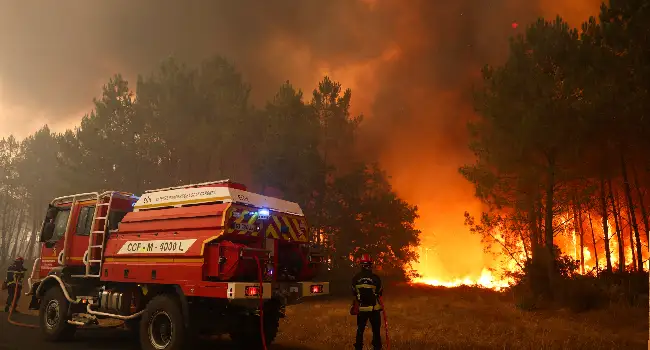
Raging wildfires sweeping across southwestern France and areas near Spain’s capital, Madrid, have forced more than 267,000 people to flee their homes, with authorities deploying military personnel and intensifying emergency operations to battle the devastating blazes.
France carried out what officials described as one of the largest peacetime evacuations in the country’s history, relocating about 197,000 people from communities around Bordeaux, including popular holiday destinations packed with tourists during the summer season.
In neighbouring Spain, approximately 70,000 residents were evacuated from villages west of Madrid as fast-moving fires continued to threaten homes and communities.
Spanish Prime Minister Pedro Sánchez, who visited the affected areas, said the government’s primary focus remained protecting lives.
“Our priority is to save lives,” Sánchez said during his visit to the wildfire zone.
The impact of the fires extended into Madrid itself, where thick smoke blanketed the skyline. AFP journalists reported that brown-grey haze covered the city while black ash settled on rooftops. Residents were forced to keep windows shut because of the heavy smoke and its irritating effects on breathing.
Among those displaced was 38-year-old Jacqueline Villafranca, originally from Peru, who fled the village of Navalagamella with her husband and two daughters on Friday.
“When smoke filled our village, I thought everything was going to burn, the house and everything,” she said.
“Here you can breathe normally — yesterday it was unbearable,” she added while staying in a gymnasium converted into an emergency shelter.
Firefighters in both France and Spain have spent several days battling the infernos around the clock, struggling to contain the flames despite signs that the intensity of some fires has eased slightly.
Authorities said no civilian fatalities had been recorded so far. However, two French firefighters lost their lives earlier this week while responding to the massive blaze near Bordeaux.
France’s Interior Minister, Laurent Nunez, said the Gironde wildfire had become less aggressive overnight than initially feared.
He explained that the fire had ceased behaving like a “convective” wildfire, a dangerous type that intensifies itself through powerful rising air currents.
Spanish authorities also reported modest progress, saying overnight weather conditions had helped slow the spread of the fires and reduce their intensity.
Despite the improvement, officials warned that the crisis remains far from over.
Prime Minister Sánchez cautioned that changing wind conditions could quickly worsen the situation.
“We are going to have some complex hours ahead because although the temperatures have gone down, we do not know exactly how the wind will develop, how strong it will be,” he warned.
Extreme Heat Fuels Historic Wildfires
Experts say prolonged drought and repeated heatwaves since May have created ideal conditions for the rapid spread of the fires across both countries.
Scientists continue to link increasingly frequent and severe wildfires to climate change, noting that Europe remains the fastest-warming continent globally.
To support overwhelmed emergency services, several European Union member states have deployed firefighting aircraft to France and Spain.
France has also mobilised 1,000 soldiers to assist emergency responders near Bordeaux.
In addition, authorities ordered an A400M military transport aircraft specially modified to release up to 20 tonnes of fire retardant to join aerial firefighting operations already underway.
French Prime Minister Sébastien Lecornu scheduled another emergency government crisis meeting on Saturday, just a day after chairing an earlier session focused on the escalating wildfire emergency.
Meanwhile, the commander of the Paris Fire Brigade confirmed that an additional 100 firefighters were being deployed to southwestern France, reinforcing the 45 personnel and six emergency vehicles already assisting local responders.
Emergency shelters have been established in schools, sports halls and exhibition centres to accommodate thousands of displaced residents and tourists uncertain about the fate of their homes.
Irish tourist Nuala Kelly, 75, described the disaster as unlike anything she had witnessed in her lifetime.
“Never, never, never, never, never, and I’ve travelled all over the world and been in all sorts of situations,” she said while taking refuge at Bordeaux’s exhibition centre.
French resident Olivier Stewart, who evacuated the village of Mérignac with his wife and young children, said the emotional toll had been especially difficult for the children.
“They think the fire is going to burn down the house, but we’re coping,” he said.
Nearly 100,000 Hectares Burned in France
Authorities say wildfires across France have now destroyed almost 98,000 hectares of land this year, setting what officials described as a historic national record.
In southwestern France alone, more than 32,000 hectares—an area roughly three times the size of Paris—have been consumed by flames, while at least 100 buildings have been destroyed.
In Spain, officials estimate that up to 25,000 hectares have already burned in the fires west of Madrid.
Authorities also confirmed that two of the country’s three largest wildfires have merged into a single blaze, raising concerns that it could combine with another fire to create an even larger inferno only a few kilometres from the Spanish capital.
Madrid government representative Francisco Martin warned that unpredictable wind gusts continued to complicate firefighting efforts, although cooler temperatures had created what he described as “a real opportunity” to gain greater control of the situation.