By MBACHU GODWIN Abuja
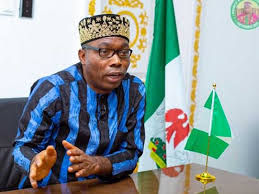
Four years after the predictions of former Social Democratic Party, SDP, presidential candidate, Prince Adewole Adebayo, on State Police and economic reforms, it has continued to draw renewed attention, even as Nigeria struggles to address its twin challenges of insecurity and economic distress.
Adebayo’s postulations particularly on state policing, revenue generation and economic management continues to dominate national discourse on current policy issues.
He argued that leadership should not shy away from crises but confront them frontally, describing Nigeria’s problems not as reasons to avoid public office but as opportunities for service.
According to him, Nigeria’s economic difficulties were less a reflection of resource scarcity and more a consequence of poor governance, weak accountability and leadership failure.
He maintained that Nigeria’s revenue challenge was overstated, insisting that the country was collecting only a fraction of what it should ordinarily generate.
Adebayo had argued that rather than imposing additional taxes on struggling citizens and businesses, government should focus on stopping leakages, curbing crude oil theft and formalising revenue collection.
He noted that the economy had been weakened by what he described as widespread diversion of public resources and the failure to secure productive sectors.
Adebayo called for deep structural reforms of law enforcement, adding that policing in Nigeria had become disconnected from communities and too centralised to deliver justice effectively.
“: Police should operate primarily as protectors of citizens rather than instruments of state authority”
Adebayo proposed placing policing within a broader justice framework and strengthening the role of the Attorney General as defender of public interest rather than merely government’s legal representative.
Endorsing state police and local government policing.then, Adebayo anchored his postulation on the principle that every level of government empowered to make laws should also possess limited authority to enforce those laws.
He maintained that effective policing requires proximity to the communities affected, adding that community-based policing would improve accountability, speed of response and citizens’ confidence in law enforcement.
Adebayo had warned that unless government rebuilt trust between security institutions and citizens, broader social instability would persist.
He, however, argued that leadership should focus less on political calculations and more on solving concrete issues including poverty, insecurity, infrastructure failure and economic productivity.
He insisted that issue-based politics would ultimately prove more sustainable than campaigns built around personalities, ethnicity or political structures
Adebayo’s remarks have resurfaced as an example of ideas that remain part of Nigeria’s unresolved governance conversation.
END