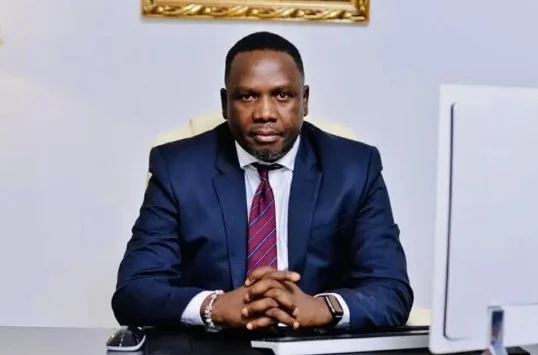
The Special Adviser to President Bola Tinubu on Media and Public Communications, Daniel Bwala, has revealed that Nigerian security forces have apprehended foreign nationals suspected of having connections with insecurity in different parts of the country.
Bwala made the disclosure while speaking during The Link Up Podcast, a panel discussion hosted by EchoRoom and released on Friday.
According to him, the involvement of foreign actors in Nigeria’s internal security challenges is closely linked to geopolitical interests and the nation’s strategic resources, particularly crude oil, as well as certain policy decisions previously taken by the Federal Government.
Recalling past events, Bwala said a particular policy decision by the Nigerian government was followed by protests in some northern states where demonstrators openly displayed Russian flags.
“If you remember, there was a decision the Federal Government of Nigeria made at that time, and immediately we started seeing people in Nigeria lifting Russian flags,” Bwala said, referring to demonstrations in parts of northern Nigeria, including Kano State.
He confirmed that security operatives had arrested foreign nationals during military operations.
“Our soldiers have arrested foreign nationals in the middle of the country,” he stated.
Bwala explained that the identities and nationalities of those arrested had not been made public because of ongoing diplomatic considerations.
According to him, revealing such information prematurely could undermine sensitive engagements between Nigeria and the countries involved.
“For security reasons, the military refused to disclose their nationality, but the government of Nigeria related with those nationalities and countries.
“If you catch somebody like that, you keep them until that country has something also in it, so you do prisoner exchange,” he said.
He added that where Nigeria maintains cordial diplomatic relations with the countries concerned, authorities prefer quiet diplomatic engagement instead of public accusations.
Bwala noted that intelligence-related matters are often handled discreetly because governments generally avoid publicly acknowledging covert operations, relying instead on what he described as plausible deniability.
Reacting to allegations regarding the possible involvement of the United States Central Intelligence Agency (CIA) in financing terrorism in Nigeria, Bwala said he could neither confirm nor dismiss the claims.
However, he recalled that the issue had previously surfaced during a hearing before the United States Congress.
He referenced comments made by American lawmaker Scott Perry, who questioned a CIA director over allegations concerning the funding of terrorist organisations.
“I’m not saying he’s right or he’s wrong, but an event like that has occurred, and as a country we cannot hear that and say you are a liar,” he said.
Speaking on the security situation in Nigeria, Bwala said terrorist organisations such as Boko Haram and the Islamic State West Africa Province (ISWAP) had gradually expanded beyond the North-East into the North-West and were attempting to establish a presence in parts of the North-Central region.
He stated that the Federal Government was intensifying military operations to prevent the insurgent groups from extending their activities into southern Nigeria.
Addressing allegations that elements within the military deliberately shield terrorists during operations, Bwala dismissed the claims as speculative.
Nonetheless, he admitted that infiltration by informants within security institutions could not be entirely ruled out.
To support his argument, he cited previous incidents involving compromised officials, including the arrest of a senior Nigerian police officer alongside Chinese nationals.
He also referenced the case of former United States intelligence contractor Edward Snowden as an example of how sensitive institutions can be infiltrated.
Bwala further criticised what he described as poor coordination between the Nigerian Army and the Nigerian Air Force during the administration of former President Muhammadu Buhari.
According to him, the lack of effective collaboration between the two military services weakened some security operations.
He, however, maintained that the Tinubu administration had addressed those operational deficiencies, resulting in improved coordination among the security agencies.
Assessing the performance of President Bola Tinubu’s administration, Bwala expressed confidence that the government had recorded measurable progress.
He pointed to improvements in Nigeria’s foreign reserves, revenue generation and economic management as evidence of the administration’s achievements.
He concluded by saying that it would ultimately be up to Nigerians to determine whether President Tinubu deserves another term in office.