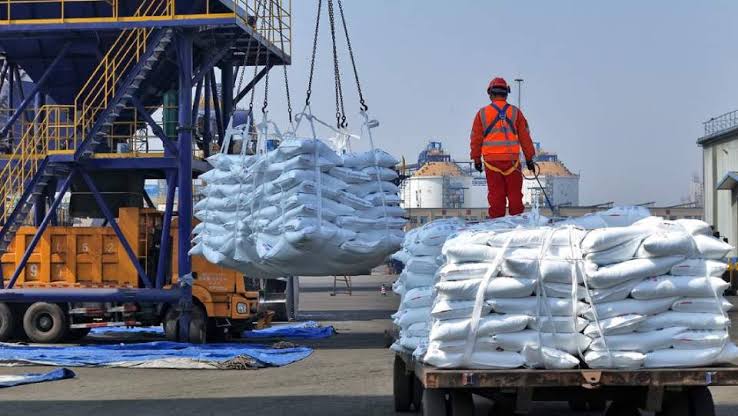
Nigeria’s fertilizer exports generated N1.37 trillion in the first quarter of 2026, making urea one of the country’s highest-earning export products and strengthening the growing role of industrial exports in Nigeria’s foreign exchange earnings.
According to the latest foreign trade statistics, fertilizer ranked behind only crude oil and natural gas among Nigeria’s leading export products during the quarter, outperforming several agricultural commodities that have historically dominated the country’s non-oil export basket.
The performance highlights the increasing contribution of value-added manufacturing to Nigeria’s export portfolio and offers a clear example of the country’s ongoing efforts to diversify foreign exchange earnings beyond crude oil.
A breakdown of Nigeria’s export earnings in Q1 2026 shows that hydrocarbons remained the dominant source of foreign exchange inflows.
Crude oil remained the country’s largest export, generating N11.20 trillion during the quarter, while natural gas contributed N2.01 trillion.
However, fertilizer emerged as the next major non-crude export product, generating N1.37 trillion in export earnings.
This is higher than several petroleum derivatives such as petroleum gases (N1.34 trillion), jet fuel (N1.33 trillion), and gas oil (N625.45 billion), amongst others.
The urea figure is also significantly ahead of leading agricultural exports such as cocoa beans, sesame seeds, cashew nuts, and soybeans.
A closer look at the data shows that fertilizer exports earned more than twice the value of cocoa exports (N596.9 billion), Nigeria’s leading agricultural export commodity.
This comparison highlights a broader shift in Nigeria’s export mix, where industrial products are beginning to command greater importance than raw commodity exports.
The urea export earned an additional N373.12 billion from the N1.00 trillion generated in Q4 2025 and an increase of N518.88 billion from N855.85 billion it earned in Q1 2025.
The urea export performance places fertilizer among the country’s most valuable export products and highlights the growing role of industrial exports in Nigeria’s external trade portfolio.
The strong performance of fertilizer exports reflects the increasing impact of Nigeria’s domestic fertilizer industry, led by the multibillion-dollar urea production capacity established by Dangote Fertilizer Plant, Africa’s largest granulated urea complex, with an annual capacity of about 3 million metric tonnes.
Since commencing full operations, the plant has positioned Nigeria as a key supplier to global markets, exporting fertilizer to countries such as Brazil, India, the United States and Mexico.
More importantly, with as much as 70%–77% of its output directed to export markets, the facility has become a major source of foreign exchange inflows as well as leveraging global market pricing power for its urea production.
The Q1 2026 trade data suggests that this industrial capacity is now being fully reflected in Nigeria’s export earnings.
The development of fertilizer exports marks a shift from the country’s reliance on exporting crude oil and raw agricultural commodities toward higher-value industrial products, as Urea exports generated N1.37 trillion in Q1 2026, improving from the N1 trillion it generated in the previous quarter and the N855.85 billion it earned a year ago.
Cocoa exports stood at about N596.9 billion
Sesame seed exports earned N153.8 billion.
Soya bean exports contributed N129.3 billion.
Cashew nut exports generated N119.8 billion during the quarter.
Unlike crude oil exports, fertilizer production creates significantly more domestic economic value across a broader industrial chain — from raw material processing to large-scale chemical manufacturing, and distribution through transport, storage, and export logistics.
The sector also benefits from structurally strong global demand, driven by rising food consumption and the need to improve agricultural productivity.
Fertilizers have played a major role in boosting global crop yields and remain essential inputs for modern agriculture.
Despite the strong growth in fertilizer exports, Nigeria’s export earnings remain heavily concentrated in the oil and gas sector. Hydrocarbon products continued to account for the vast majority of foreign exchange inflows during the quarter.
Oil and gas-related products generated approximately N17.93 trillion in export earnings, accounting for nearly 85% of total export earnings in Q1 2026.
Total non-oil exports stood at N3.19 trillion during the quarter.
Fertilizer alone contributed more than 40% of total non-oil export earnings.
Notably, urea fertilizer export exceeded the one trillion-naira threshold it generated in the previous quarter to N1.37 trillion.
The rise of fertilizer as over a trillion-naira export product offers a clear pattern of what successful export diversification could look like for Nigeria.
While crude oil still dominates the country’s foreign exchange earnings, the growing contribution of industrial products such as fertilizer (Urea) suggests that manufacturing-led exports can play a more significant role in strengthening the country’s external sector.
As policymakers continue to push for export diversification, fertilizer’s performance offers a practical demonstration of leveraging existing resources, processing them locally, and exporting higher-value products to global markets.
This approach will help generate substantial foreign exchange earnings and reduce Nigeria’s dependence on crude oil over time.