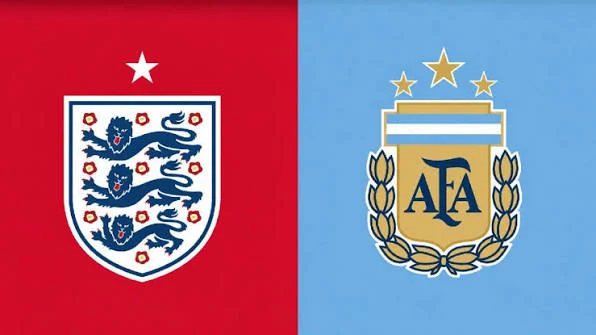
England and Argentina are set to renew one of football’s fiercest rivalries on Wednesday when they clash in the semi-finals of the 2026 FIFA World Cup after overcoming Norway and Switzerland respectively in the quarter-finals.
The encounter promises to be one of the tournament’s biggest fixtures, with both nations aiming for a place in the final and carrying decades of history into the contest.
For Argentina, victory would keep alive their ambition of becoming the first country to successfully defend the FIFA World Cup since Brazil achieved the feat in 1962.
Led by captain Lionel Messi, the defending champions remain on course for consecutive world titles after overcoming Switzerland 3-1 in extra time on Saturday.
England, meanwhile, are chasing a different piece of history. The Three Lions are hoping to end a 60-year wait for a major international trophy, with the partnership of Jude Bellingham and Harry Kane expected to spearhead their challenge.
The winner of Wednesday’s semi-final will face either France or Spain in the World Cup final scheduled for July 19. France and Spain meet in the first semi-final on Tuesday in Texas.
Wednesday’s meeting between England and Argentina also revives memories of one of the most famous matches in World Cup history.
The two nations last met in the tournament during the quarter-finals of the 1986 FIFA World Cup in Mexico, where Argentina secured a dramatic 2-1 victory thanks to two unforgettable goals from Diego Maradona.
The first goal, famously known as the “Hand of God,” saw Maradona punch the ball into the net before the referee awarded the goal.
Moments later, he scored what is widely regarded as one of the greatest goals in football history after dribbling past several England players from inside his own half.
Beyond football, the rivalry also carries political significance because of the long-standing dispute over the Falkland Islands, known in Argentina as the Malvinas.
The sovereignty dispute intensified in 1982 when Argentina invaded the islands before Britain launched a military operation to regain control.
Despite the historical tension surrounding the fixture, Argentina coach Lionel Scaloni insisted the focus should remain solely on football.
“The message is this is a football game. That’s what I can say,” Scaloni said.
“It is a football game and we will be playing against a very tough opponent. They have an excellent coach, and this is a football game and that’s all.”
Argentina booked their place in the semi-finals after eventually defeating a determined Switzerland side in Kansas City.
The South Americans secured a 3-1 victory after extra time through goals from Julián Álvarez and Lautaro Martínez, with Messi providing a crucial assist as they finally broke down Swiss resistance.
England also required extra time to progress after surviving a major scare against Norway in Miami.
The Scandinavian side took the lead in the 36th minute through Andreas Schjelderup, who fired a powerful effort beyond the England goalkeeper after exploiting defensive uncertainty.
However, England equalised deep into first-half stoppage time through Jude Bellingham following a controversial sequence of events.
Norwegian players protested after claiming a goal kick from goalkeeper Ørjan Nyland had struck an overhead television camera cable before England regained possession.
Despite the complaints, play continued and Bellingham found the net to restore parity.
Norway also had a goal ruled out during the contest before Bellingham struck again in extra time to complete England’s comeback and seal a 2-1 victory.
England manager Thomas Tuchel admitted his side fell below expectations and warned that significant improvement would be required against Argentina.
“We made life very, very difficult for ourselves today,” Tuchel said afterwards.
“The result is fantastic. The last four is amazing, but not happy with the performance… we were very lucky today.”
Following the controversy surrounding England’s equaliser, FIFA later stated there was “no evidence” that the ball had made contact with the overhead cable before the attack developed.
Norway coach Ståle Solbakken, however, remained convinced the incident influenced play.
“That was unlucky for us,” Solbakken said.
“The ball fell straight down from the sky, so it changed its direction. But we can’t do anything about that.”
Although Norway’s World Cup campaign ended in disappointment, captain Erling Haaland expressed pride in what the team achieved.
The Manchester City striker, who failed to score for the first time in 15 competitive appearances for Norway, said the tournament had inspired a new generation of footballers in his country.
“How we put Norway on the map is maybe one thing that touches me the most,” Haaland said.
“Hopefully now we can establish something when it comes to Euros, World Cups and everything because our generation is amazing and also all this gives motivation to young people back in Norway that it’s possible to play a big stage in the world with a Norwegian shirt.”
With a place in the World Cup final at stake, England and Argentina now prepare for another chapter in one of international football’s greatest rivalries, this time with both teams determined to write new history on the sport’s biggest stage.