By Blessing Otobong-Gabriel
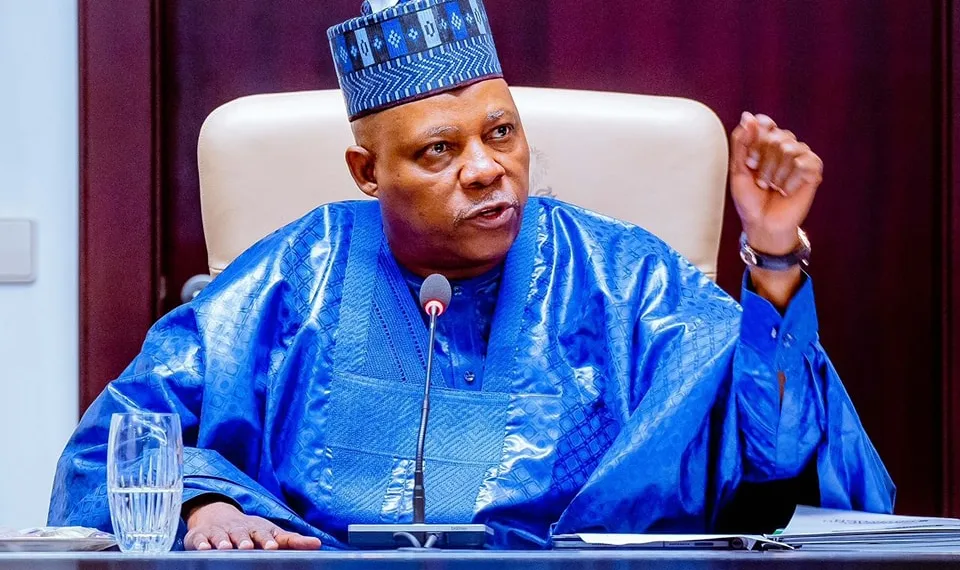
Vice President Kashim Shettima has reaffirmed the Federal Government’s commitment to building Nigeria’s economy through digital innovation, describing technology as the pathway to inclusive growth, stability, and global competitiveness.
Speaking at the Digital Nigeria International Conference 2025, in abuja, a flagship initiative of NITDA that brings together Nigeria’s tech, startup, and innovation communities which serves as a strategic platform for showcasing breakthroughs, exchanging ideas, and exploring global trends aligned with Africa’s digital transformation agenda Shettima said the development of modern economies is driven by innovation, creativity, and digital transformation.
He emphasized that Nigeria possesses one of the most vibrant pools of talent in the world, capable of defining the next chapter of global progress.
He noted that the administration of President Bola Ahmed Tinubu is determined to ensure Nigeria does not miss the opportunities presented by the ongoing digital revolution, having been left behind in previous industrial eras.
According to him, five out of Africa’s nine technology unicorns are Nigerian companies, with more promising startups emerging across the country.
He described this as proof that Nigerian innovators are leading Africa’s digital transformation.
Shettima said the government’s economic reforms are already yielding positive results, citing improved investor confidence and favorable assessments from international rating agencies.
He added that digital innovation represents a sustainable and inclusive solution to Nigeria’s quest for relevance and transformation, stressing that the government can no longer apply “20th-century solutions to 21st-century problems.”
The Vice President outlined the government’s digital economy strategy built on three pillars people, infrastructure, and policy.
On people, he said the government is investing heavily in digital literacy and technical skills through initiatives such as the Three Million Technical Talent (3MTT) program and the Digital Literacy for All Initiative, which aims to integrate digital education into school curricula and empower the informal sector.
On infrastructure, Shettima said the government is constructing a broadband “superhighway” to ensure nationwide high-speed internet connectivity that supports startups and remote work opportunities across rural and urban areas alike.
On policy, he revealed that the government is in the advanced stage of passing the National Digital Economy and E-Governance Bill into law — a step he said would usher in a new era of smarter governance, transparency, and inclusive service delivery.
Shettima commended Nigeria’s young innovators, describing them as “the true drivers of national progress.”
He added that digital success means empowering every Nigerian from farmers accessing real-time market data to young women in rural areas working remotely for global firms through improved connectivity.
Vice President Shettima emphasized that the Tinubu administration’s digital innovation agenda aligns with its broader economic reform strategy to build a resilient, inclusive, and technology-driven economy.
Speaking, Minister of Communications, Innovation and Digital Economy, Dr. Bosun Tijani, says Nigeria’s digital sector is on track to surpass oil and gas in national economic contribution, driven by government reforms, innovation, and strategic investments in connectivity and talent development.
The Minister described the forum as a reminder of the nation’s digital journey from its early reforms to current strides in building a technology-powered, inclusive economy.
Tijani traced Nigeria’s digital transformation to the liberalisation of the telecommunications sector in 1999, which he said marked a turning point in national growth.
He disclosed that Nigeria is currently leading one of the world’s largest connectivity projects a 90,000-kilometre open-access fibre network backed by the World Bank aimed at delivering high-speed internet to every part of the country. The project, now approved by the National Assembly, includes the installation of 4,000 new telecommunications towers to serve over 20 million Nigerians currently without network coverage. “This is the largest digital infrastructure project ever funded by the World Bank,” the Minister said.
Tijani further revealed that the government is investing in artificial intelligence (AI) and data systems to deepen innovation and governance efficiency.
Nigeria, he noted, was the first country to use AI to identify researchers and professionals in the field globally, bringing 120 of them together to develop a national AI strategy now ranked among Africa’s best. “We have funded 55 AI research projects and are building a national data exchange system to ensure secure data sharing across government and the private sector,” he said, adding that these initiatives align with the administration’s vision to create one million technical jobs and position Nigeria as a global digital powerhouse.
The Director-General of the National Information Technology Development Agency (NITDA), Kashifu Inuwa Abdullahi, described Nigeria’s youth as the nation’s greatest asset, stressing that their creativity and innovation are key to building a prosperous digital economy.
He expressed appreciation to Vice President Kashim Shettima for his presence at the Digital Nigeria Conference, noting that it demonstrates the administration’s strong commitment to empowering young people.
Abdullahi recalled that President Bola Ahmed Tinubu, upon assuming office, made economic diversification and inclusivity central to his Renewed Hope Agenda.
He said two of the President’s eight priority areas—reforming the economy for inclusive growth and accelerating diversification through digitalisation—directly align with the theme of this year’s conference, “Innovation for a Sustainable Digital Future: Accelerating Growth, Inclusion, and Global Competitiveness.”
Highlighting Nigeria’s demographic advantage, the NITDA boss noted that with a population of over 220 million and an average age of 18, the country’s youthful population can either become its greatest dividend or a major challenge depending on how it is harnessed.
Abdullahi announced that this year’s conference has attracted more than 4,800 participants from 12 countries and 25 Nigerian states, making it both national and international in scope.
He encouraged participants to use the event as a platform for collaboration, learning, and opportunity creation. “From every panel to every handshake, let our message be clear: Nigeria can do it—and we will do it,” he said.