By Henry Ibya, Makurdi
The Director of Programmes, Concerned Women International Development Initiative,CWIDI, Mrs. Bridget Okeke, has expressed optimism that equipping Adolescent Girls and Young Women, AGYW,with leadership, advocacy, and human rights skills is critical to driving change in structural systems, punitive laws, and harmful gender norms that affect their health and rights.
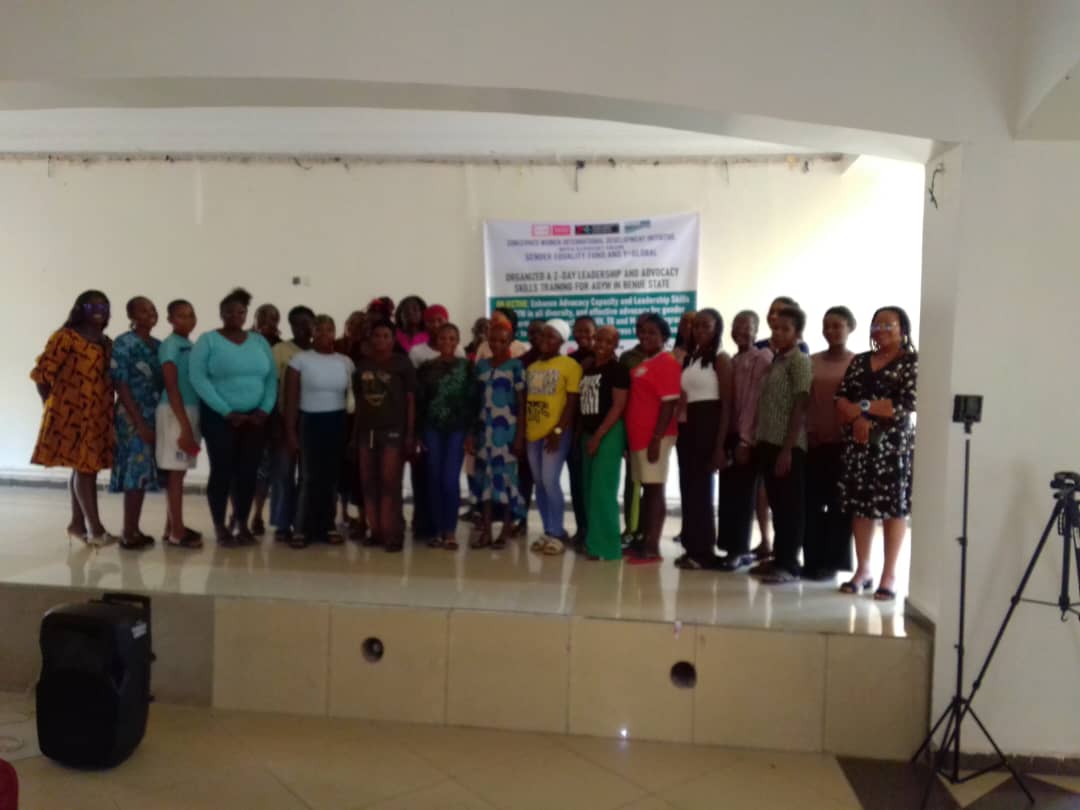
Mrs. Okeke, who made the remarks during a two-day capacity-building workshop on Leadership and Advocacy organized by CWIDI in collaboration with the Gender Equality Fund and Y+Global, held at Hallydays Hotel Makurdi, explained that the training is aimed at strengthening the voice and agency of 32 AGYW participants drawn from across Benue State.
She emphasized that the knowledge gained from the workshop would enable AGYW to meaningfully contribute to policy and decision-making processes that directly impact their health and well-being.
“Many vulnerable women, especially adolescents, have suffered injustice and gender-based violence in silence,” Okeke said, stressing that the training will empower them to understand their rights, recognize when those rights are violated, and know what actions to take.
She added that the knowledge acquired would not only benefit the participants but also their communities, pointing out that as young people and particularly women,knowing their rights and responsibilities, would equip them better to make informed choices and contribute positively to society.
Okeke described as essential investing in youth leadership and advocacy, acknowledging that such an exercise would prepare the next generation for responsible leadership.
She equally noted that AGYW could apply the leadership, advocacy skills and human rights knowledge gained to advocate against gender-based violence and for transformative approaches to HIV/AIDS, Tuberculosis (TB), as well as Malaria programmes thereby improving health outcomes.
According to CWIDI’s Director of Programmes,the participants will use the skills acquired to take active roles in decision-making processes, monitor implementation and evaluation of AGYW programmes, and contribute to community-led monitoring initiatives.
She appreciated the Benue State Government for providing an enabling environment for CWIDI’s work and assured participants that the organization would continue to design programmes that benefit young people.
In his presentation on the Concept of Leadership, Mr. Joseph Abanyi from the state ministry of health outlined six leadership styles transformational, democratic, autocratic, laissez-faire, and servant leadership encouraging participants to adopt the democratic and servant leadership approaches as they are more result-oriented.
Abanyi also urged AGYW to engage actively in community decision-making processes by identifying key stakeholders, building trust, promoting dialogue, and taking collective action.
Speaking on “Understanding Rights and Legal Protections under the Violence Against Persons Prohibition (VAPP) Law,” Barr. Justin Gbagir emphasized that advocacy against gender-based violence must be grounded in knowledge of the law.
He recalled that the Benue State Government domesticated the VAPP Law in 2019, following the federal enactment in 2015, to eliminate all forms of violence against persons in both public and private spaces, listing offenses under the law to include rape, spousal battery, female genital mutilation, harmful widowhood practices, deprivation of liberty, intimidation, and other forms of abuse.
Gbagir noted that cases of gender-based violence persist largely due to underreporting and urged victims to speak out and report violations to the appropriate authorities, including the police, family courts, magistrate courts, and the high court.
Participants described the training as enriching, impactful, and empowering, and appealed to CWIDI and its partners to sustain the initiative to reach more young women across the state.