
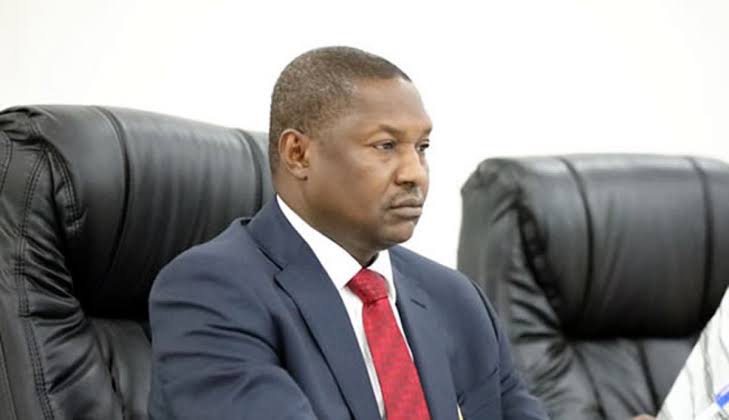
The Federal High Court in Abuja has ordered the permanent forfeiture of 48 properties linked to former Attorney-General of the Federation and Minister of Justice, Abubakar Malami, to the Federal Government over alleged proceeds of unlawful activities.
Justice Joyce Abdulmalik delivered the judgment on Wednesday, holding that the assets, which were allegedly acquired with proceeds of crime, should be permanently confiscated by the government.
The court ruled that Malami, who served as Nigeria’s Attorney-General and Minister of Justice between November 11, 2015, and May 29, 2023, under the administration of former President Muhammadu Buhari, failed to sufficiently dispel the reasonable suspicion surrounding the source of funds used to acquire the properties.
Justice Abdulmalik also dismissed arguments that some of the disputed assets belonged to the wider Malami family in Kebbi State.
According to the court, the central issue was not ownership but whether the money used to purchase the properties was legitimately earned.
The judge maintained that Section 17 of the Advance Fee Fraud and Other Fraud Related Offences Act empowers the court to order the final forfeiture of assets found to have been acquired through illicit means.
The judgment followed an application filed by the Economic and Financial Crimes Commission (EFCC).
Although the anti-graft agency initially sought the forfeiture of 57 high-value properties allegedly traced to the former minister, the court found sufficient evidence establishing the legitimate ownership of nine of the assets and excluded them from the forfeiture order.
The parties had adopted their final written addresses before the court on May 26.
The EFCC had earlier secured an interim forfeiture order covering the properties, which it estimated to be worth more than N212 billion.
According to the commission, the assets, located across Kebbi, Kano, Kaduna and the Federal Capital Territory, Abuja, were reasonably suspected to have been purchased with proceeds of crime.
The commission told the court that the interim order was necessary to preserve the assets pending the determination of its application for final forfeiture.
Malami is currently standing trial on a 16-count charge bordering on alleged money laundering.
He was arraigned alongside his son, Abdulaziz Malami, and one of his wives, Hajia Bashir Asabe.
The EFCC alleged that the defendants laundered public funds amounting to about N9 billion.
According to the anti-corruption agency, the former Attorney-General concealed the proceeds of the alleged crimes by acquiring luxury properties in different parts of the country.
After granting the interim forfeiture order, the court directed the EFCC to publish a public notice within 14 days inviting anyone with an interest in any of the listed properties to appear before the court and show cause why they should not be permanently forfeited.
Challenging the interim order, Malami’s legal team urged the court to set it aside, insisting that all the affected properties were lawfully acquired.
He argued that the assets had been properly declared in his asset declaration forms submitted to the Code of Conduct Bureau (CCB) in accordance with constitutional requirements.
According to him, the EFCC failed to establish any prima facie evidence linking the properties to criminal proceeds.
Malami further accused the anti-graft agency of withholding material facts from the court.
He argued that the commission sought forfeiture of assets “that were lawfully acquired post-appointment of the respondent/applicant and declared with the Code of Conduct Bureau as legitimate assets of the respondent/applicant, in compliance with the 5th Schedule to the Constitution of the Federal Republic of Nigeria, in 2019 and 2023.”
He also alleged that the interim forfeiture order was obtained through “manifest exaggeration, malicious inflation of the value of the assets, and unreasonable and incompetent valuation deliberately manipulated to mislead the court, negatively affecting its discretion in granting an order based on manipulated facts and conclusions deliberately cooked up by the applicant/respondent (EFCC).”
While adopting the EFCC’s final address, senior advocate Jibrin Okutepa urged the court to grant the application for permanent forfeiture, relying on a 47-paragraph affidavit and 46 documentary exhibits tendered before the court.
Okutepa argued that Malami had failed to satisfactorily explain the legitimate source of funds used to acquire the properties.
In response, Malami’s counsel, Adedayo Adedeji, SAN, urged the court to dismiss the application, arguing that the commission’s case was built largely on suspicion rather than credible evidence.
He relied on Malami’s counter-affidavit to insist that the properties were legitimately acquired and properly declared.
Among the properties affected by the forfeiture order are a luxury duplex on Amazon Street in Maitama, Abuja; a five-storey hotel in Jabi District; Meethaq Hotels in Maitama; several residential buildings in Asokoro, Gwarimpa and Wuse II, Abuja; commercial properties in Kano and Kebbi States; farmland covering about 100 hectares along the Birnin Kebbi–Jega Road; warehouses, shopping plazas and multiple residential developments.
Also listed are properties acquired through the Khadimiyya for Justice & Development Initiative, including nine three-bedroom bungalows, three two-bedroom bungalows and about 5.4 hectares of land purchased through the Federal Housing Authority Mortgage Scheme.