Joel Ajayi
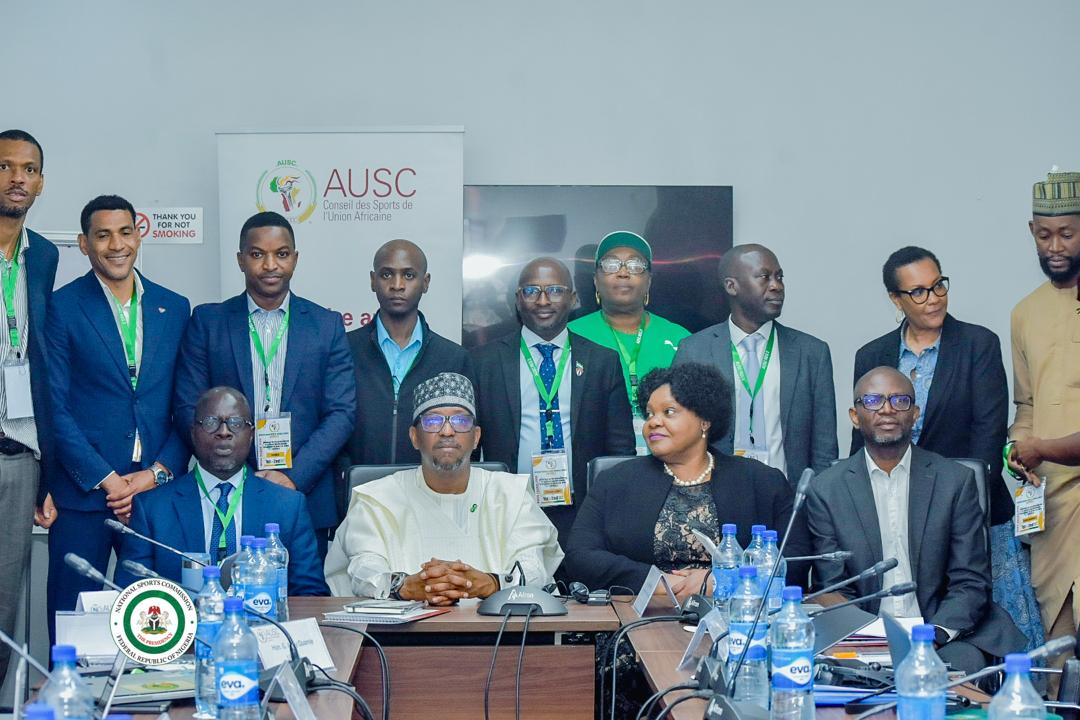
The African Union Sports Council (AUSC) has intensified efforts to reposition sports as a major driver of socio-economic development across the continent, convening a high-level regional workshop for West African member states Zone 2 in Abuja.
The meeting, focused on the popularisation and implementation of the African Union’s Framework for the Sustainable Development of Sports in Africa, brought together directors of sports and technical experts from 15 countries in the region to harmonise policies and share best practices.
Speaking at the event, Chairman of the National Sports Commission, Malam Shehu Dikko, stressed the importance of unity in driving sports development across Africa.
He explained that the workshop provides a platform for countries to compare progress, exchange ideas, and align their strategies with the AU’s broader vision.
According to him, the goal is to ensure that sports development across the continent follows a coordinated framework rather than fragmented national approaches.
“This engagement is about bringing countries together to share ideas, assess what each nation is doing, and harmonise our development process. We must avoid a situation where countries move in different directions. Instead, we need a unified framework that drives sports as an economic and social tool,” Dikko said.
Dikko also highlighted Nigeria’s growing leadership role in continental sports, especially as the country prepares to host the 2031 African Games.
He described the meeting as vital in showcasing Nigeria’s readiness and strengthening confidence among African stakeholders.
“Inspectors from the African Union have been engaging with us over the past few days to assess our preparedness. With representatives from across the region present, they can see firsthand our infrastructure, capacity, and the opportunities Nigeria offers,” he added.
He further revealed that the Federal Government has approved a National Sports Infrastructure Development Bond aimed at upgrading and maintaining sporting facilities nationwide. This, he said, will position Nigeria to host major international competitions seamlessly across different regions.
Reflecting on Nigeria’s previous Commonwealth Games bid, Dikko clarified that the country did not fail but instead secured the right of first refusal to host the 2034 edition, while India prepares to host the 2030 Games. He expressed optimism that successfully hosting the 2031 African Games would strengthen Nigeria’s chances for future global events.
Also speaking, Acting Director for Social Development, Culture and Sport at the AUSC, Dr Angela Martins, emphasised the significance of the continental policy adopted in 2023 by the African Union Executive Council.
She explained that the framework is designed to encourage member states to prioritise sports as a strategic tool for economic growth, youth empowerment, and regional integration.
“Following the adoption of the policy, the AU has embarked on advocacy and sensitisation campaigns across regions. Last year, we engaged East Africa, and this year we are focusing on West Africa to deepen understanding and implementation,” she said.
Martins commended the Government of Nigeria and the National Sports Commission for hosting the workshop and supporting its success.
In his remarks, Overall Head of the African Union Sports Council Region 2, Dr Decius Chipande, noted that the workshop is aimed at translating the continental policy into actionable national strategies.
He said participating countries would review their existing sports policies and assess their alignment with AU objectives, ensuring more effective implementation at the national level.
Chipande also outlined the AU’s regional sports structure, explaining that Africa is divided into five development regions, each expected to maintain strong coordination and functional systems to drive growth.
He stressed that the ultimate objective is to position sports as a key contributor to the African Union’s Agenda 2063 — the vision for “the Africa we want.”
The workshop is expected to strengthen collaboration among West African nations, accelerate policy harmonisation, and unlock the full potential of sports as a catalyst for sustainable development across the region.
Xxxxxxxxxxxxxxxxxxx
Team Nigeria Unveils Ambassadors for Glasgow 2026 Commonwealth Games
Joel Ajayi
The National Sports Commission (NSC) has officially unveiled a list of distinguished Team Nigeria Ambassadors ahead of the 2026 Commonwealth Games, reflecting the country’s commitment to a strong and impactful outing at the global multi-sport event.
In a statement signed by Commission’s
Director, Press Dr. (Mrs.) Kehinde Ajayi, on Wednesday in Abuja stated that list, as approved by the Commission, features prominent figures across sports administration, athlete representation, and corporate partnership.
Amongst the delegation of ambassadors is Mallam Saleh Ahmadu, alongside respected stakeholderi including Dr. Amos Adamu, Chief Patrick Ekeji, Alhassan Yakmut, Gbenga Elegbeleye.
These experienced administrators previously served as Director General of the NSC, and thus, carry tremendous wealth of experience that will benefit Nigeria at the Games and beyond.
Also named are ex elite athletes and stakeholders such as Olympic medalist Daniel Igali, Blessing Oborodudu, Tajudeen Ogunbade, Khadijat Sulaiman, Victor Iroele, as well as a representative from Premium Trust Bank and the Comptroller General of Nigeria Customs, Wale Adeniyi.
The appointment of these ambassadors underscores Nigeria’s strategic approach to blending experience, technical expertise, and athlete representation in preparation for the Games.
The 2026 Commonwealth Games is scheduled to hold in Glasgow, Scotland from July 23 to August 2, 2026, bringing together over thousands of athletes from approximately 74 Commonwealth nations and territories.
The Games will feature a streamlined programme of 10 sports, including athletics, swimming, boxing, cycling, and gymnastics, with full integration of para-sports, highlighting inclusivity and elite competition on a global stage.
The unveiling of Team Nigeria Ambassadors signals a renewed drive by the National Sports Commission to strengthen preparation, enhance athlete support systems, and boost Nigeria’s global sporting presence.