The Chairman and Chief Executive Officer of the National Drug Law Enforcement Agency (NDLEA), Brig. Gen. Buba Marwa (retd.), has disclosed that the agency arrested 77,859 suspected drug offenders and confiscated more than 14.8 million kilograms of illicit substances between 2021 and 2025.
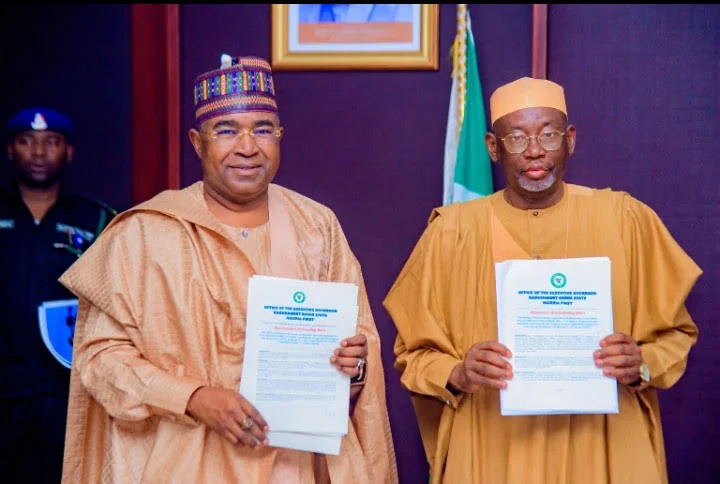
Marwa made the disclosure on Tuesday during the signing of Executive Orders on the campaign against drug abuse and mass mobilisation for societal reorientation by Jigawa State Governor, Umar Namadi, in Dutse, the state capital.
Addressing stakeholders at the ceremony held inside the Council Chamber of the Government House, Marwa described the occasion as more than the inauguration of a committee, saying it represented a decisive step in the fight against drug abuse and its impact on Nigerian society.
“I stand before this distinguished audience gathered here today not merely to inaugurate a committee, but to fortify a frontline in the battle for the soul of our youths and the stability of our nation,” he said.
The NDLEA chairman warned that drug abuse has become a major driver of insecurity, criminality and economic disruption across the country.
“Let us be clear, drug abuse is the silent pandemic fueling the insecurity and economic sabotage we face today. It erodes the productivity of our greatest asset, our youth,” Marwa stated.
He explained that the agency had shifted from a largely reactive strategy to a more aggressive operational approach, leading to significant achievements over the last five years.
“Between January 2021 and December 2025, our balanced approach has yielded unprecedented results with 77,859 arrests, including 240 high-profile drug barons who thought they were untouchable.
“Over 14.8 million kilograms of illicit substances were intercepted while 14,122 convictions were secured within the period,” proving that the era of impunity is over.
Marwa also revealed that the NDLEA had prioritised rehabilitation alongside law enforcement, noting that thousands of individuals battling drug addiction had received treatment and counselling.
“In the same vein, over 50,000 individuals have been counselled and rehabilitated across 31 of our treatment centres nationwide, moving from the darkness of dependence to the light of productivity,” he added.
The NDLEA boss praised the Jigawa State Government for introducing proactive measures to tackle drug abuse and improve public safety.
“Under the visionary leadership of His Excellency, Umar Namadi, Jigawa is proving that proactive governance is the best antidote to social malaise,” he said.
Marwa described the newly inaugurated State Task Force as a model worthy of replication across Nigeria.
“I call upon other State Governments across the Federation to look toward Dutse today and emulate this strategic blueprint for domesticating the war against drug abuse,” he said.
He also commended the appointment of retired Comptroller of Narcotics Ibrahim Braji as the coordinator of the task force, describing it as a well-considered decision.
“The appointment of CN Ibrahim Braji (Rtd) as Coordinator is a masterstroke. Having served as an NDLEA State Commander, he brings a veteran’s perspective and a strategist’s precision,” Marwa noted.
He urged Braji to provide effective leadership in driving the campaign against drug abuse in the state.
“To the Coordinator: your track record precedes you, and we expect nothing less than transformative leadership,” he added.
Marwa further disclosed that the agency’s War Against Drug Abuse (WADA) campaign had reached millions of Nigerians through public awareness initiatives.
“Through our War Against Drug Abuse (WADA) initiative, we haven’t just cleared the streets, we have cleared minds,” he said.
While acknowledging that the North-West records an estimated drug prevalence rate of about 12 per cent, Marwa said Jigawa currently stands at approximately seven per cent, cautioning that the state should not become complacent.
“Data tells us that the North West faces a drug prevalence rate of roughly 12%. Yet, Jigawa stands at 7%. Let us not mistake a lower percentage for a permanent shield.
“This Task Force is a preemptive strike. It is about ensuring that the 7% does not climb, but instead drops toward zero. We are therefore here to protect the ‘Jigawa Advantage,’” he stated.
Speaking at the event, Governor Umar Namadi explained that the Executive Orders were designed to protect the future of young people in the state.
“I am delighted that we are gathered today for this significant event in our collective effort to protect the promise of our young people and renew the moral strength of our communities,” the governor said.
“We are especially honoured by the presence of our Special Guest, Brig. Gen. Mohammed Buba Marwa (Rtd.), whose presence and keynote address reinforce the seriousness of the cause before us,” he added.
Namadi noted that the Executive Orders align with his administration’s 12-point development agenda by addressing drug abuse while promoting patriotism, discipline and responsible citizenship.
“The two Executive Orders directly address these commitments: one establishes a structured campaign against drug abuse. The other promotes patriotism, honesty, discipline, respect for the law and civic responsibility,” he stated.
The governor also linked the August 2024 nationwide protests to the dangers posed by unemployment, misinformation and substance abuse among young people.
“The violence recorded in many States, including Jigawa, exposed how easily young people can be drawn into destructive conduct when frustration, misinformation and idleness converge,” he said.
Namadi stressed that with more than 60 per cent of Nigeria’s population under the age of 30, investment in youth development remains critical.
“A youthful population is a powerful asset only when it is educated, skilled, healthy and morally grounded. A major threat is drug and substance abuse,” he warned.
Responding on behalf of the newly inaugurated task force, retired Comptroller of Narcotics Ibrahim Braji pledged to justify the confidence reposed in him.
He said the task force would collaborate closely with local communities, traditional institutions and religious leaders to identify drug abuse hotspots while ensuring victims receive appropriate support.
Braji assured that the initiative would produce tangible results rather than remain symbolic.
He added that while offenders would be prosecuted in accordance with the law, individuals seeking rehabilitation would receive compassionate care and treatment.