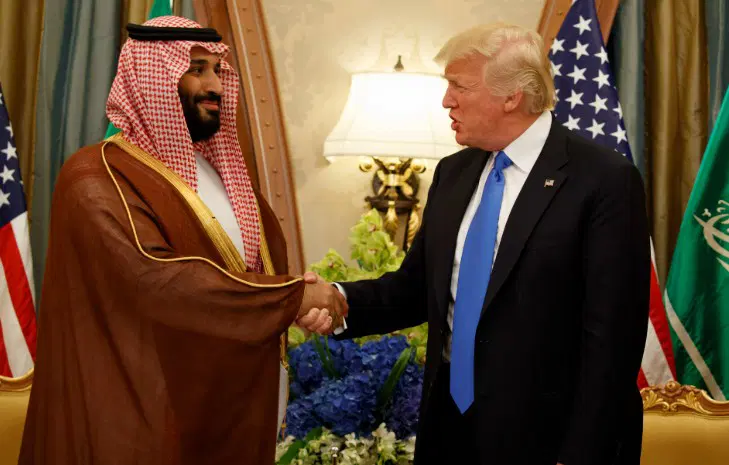
The United States is expected to formally announce a landmark agreement with Saudi Arabia on Wednesday that will pave the way for the Kingdom to establish a civilian nuclear programme, according to media reports, even as regional tensions continue to rise following renewed clashes involving Iran-backed Houthi rebels in Yemen.
The New York Times, citing two unnamed U.S. officials, reported on Tuesday that the administration of President Donald Trump intends to sign and unveil the agreement during an official ceremony on Wednesday.
According to the report, the deal is expected to generate billions of dollars in opportunities for the American nuclear industry through long-term cooperation with Saudi Arabia.
The Wall Street Journal also reported that the agreement, which would remain in force for 30 years, contains a provision allowing American companies to construct a uranium enrichment facility in Saudi Arabia if a joint feasibility assessment concludes that such infrastructure is necessary.
Despite the anticipated economic benefits, the proposal has generated opposition from some lawmakers in the United States, cutting across both Republican and Democratic parties, as well as concerns from Israeli officials.
Critics argue that although the programme is being presented as civilian in nature, the technology involved could potentially be adapted in the future for the development of nuclear weapons.
The agreement is expected to be transmitted to the U.S. Congress within the next few days.
However, reports indicate that congressional approval is not required before the arrangement can take effect.
The announcement comes against the backdrop of renewed instability in the Middle East, where Iran and the United States have once again become embroiled in heightened military tensions.
Earlier this week, the Houthi movement in Yemen, which is backed by Iran, threatened to widen the regional conflict by imposing a blockade on Saudi Arabian ports.
Last week, Saudi Arabia and the Houthis exchanged cross-border fire for the first time in several years, raising concerns that the fragile truce reached in 2022 could collapse completely.
Although the Yemeni rebels largely remained on the sidelines after Israel and the United States launched military operations against Iran in late February, recent developments suggest they may now be taking a more active role in the expanding regional confrontation.
The proposed nuclear cooperation agreement is therefore emerging at a time of growing geopolitical uncertainty, with concerns that further escalation between Iran, its regional allies and U.S.-backed partners could undermine stability across the Gulf.