By MBACHU GODWIN, Abuja
Former National Chairman of the All Progressive Congress, APC, and Kano State governor, Abdhllahi Umar Ganduje has called for stronger political Ideology for political parties in the country to strengthen internal democracy, deepen Democratic culture and enhance public confidence in Political process
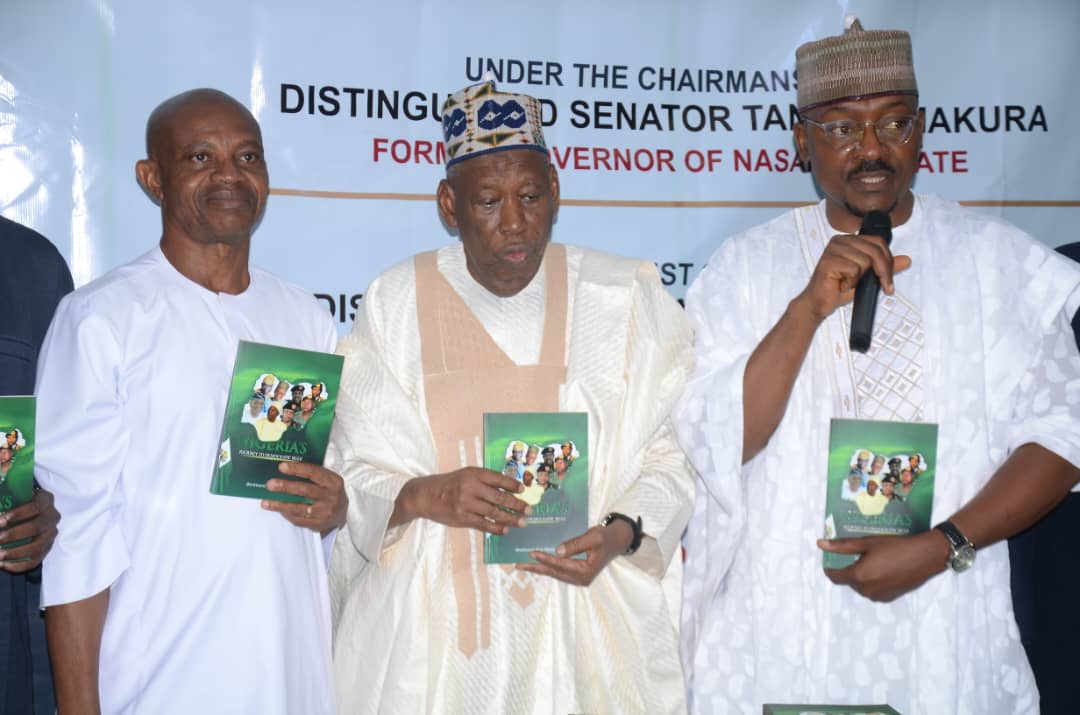
Ganduje made the call at a public presentation of a book in Abuja Wednesday titled ” Nigeria’s Journey to Democratic Rule ” written by Mr. Onyekachi Eze , Abuja bureau Chief of the New Telegram Newspaper.
The APC Chieftain lamented the absence of ideologies for political parties in Nigeria , describing it as responsible for weakening political stability and national development.
He said ” As we continue to strengthen our democratic institutions, these pillars must remain firmly protected because they are the foundation of political stability, national unity and sustainable development.
“One area that deserves serious reflection is the issue of ideology in our political parties. Political parties are expected to be driven by clear philosophies, programmes and policy directions that distinguish one from another.
“Unfortunately, the absence of strong ideological foundations has, over the years, weakened party politics, encouraged defections based on personal interests rather than principles, and made it more difficult for citizens to identify clear policy alternatives.
Strengthening internal democracy and promoting issue-based politics will undoubtedly deepen our democratic culture and enhance public confidence in the political process.
“I commend the author for the painstaking research that has gone into producing this book. By carefully documenting important milestones in Nigeria’s democratic history, he has made a valuable contribution to scholarship and national discourse.
“This publication serves not only as a historical record but also as a mirror through which political leaders, policymakers, scholars and citizens can reflect on our democratic journey, celebrate our progress and identify areas that require further improvement.
I have no doubt that this book will become an important reference material for students, researchers, political actors and everyone interested in understanding the evolution of democracy in Nigeria. It deserves to be widely read because a nation that understands its history is better prepared to shape its future.
“As we celebrate this intellectual contribution, we must also reaffirm our collective commitment to protecting and strengthening our democracy. While no democratic system is perfect, Nigeria has continued to make steady progress through the resilience of its institutions and the commitment of its people.
“Today, we can confidently say that democracy has come to stay in Nigeria. Our responsibility is to continue nurturing it by strengthening our institutions, upholding the rule of law, promoting credible elections, encouraging principled political leadership and ensuring that democracy continues to deliver dividends to the Nigerian people.
Similarly, former Nassarawa state governor and chairman of the book launch , Sen. Tanko Al -Makura who commended the author for his intellectual prowess urged Nigerians to be committed in strengthening democratic institutions
He said “The book we are presenting today chronicles our not-too-distant past. It tells the story of Nigeria’s democratic journey. It serves as a compass, helping us understand who we are as a people while highlighting both our successes and our mistakes. It is a book that deserves a place on the shelves of political leaders, scholars, students, and every patriotic Nigerian, serving as a guide for leadership, governance, and nation-building.
Ladies and gentlemen, we all share a collective responsibility to preserve and strengthen our multiparty democracy. No democracy anywhere in the world is perfect—not even those of the oldest and most advanced democracies. The true beauty of democracy lies in the peaceful contest of ideas, respect for the rule of law, and the ability of citizens to freely choose their leaders.
Our democracy is only 27 years old, spanning just seven election cycles. Compared with older democracies such as that of the United States, or even South Africa, where majority rule began in 1994, our democratic journey is still relatively young. Yet, within this short period, our electoral system has witnessed remarkable progress, evolving from entirely manual processes to the deployment of technology in voter accreditation, result management, and electoral administration.
One significant milestone was the recent inclusion of Section 60(3) of the Electoral Act, 2026, which empowers the Independent National Electoral Commission (INEC) to adopt both electronic and manual methods in the management of election results. This represents another important step in the continuous evolution of our electoral system.
As a nation, we have invested enormously; through sacrifice, resilience, and perseverance, in sustaining democratic governance. We cannot afford to allow these hard-earned gains to slip away.
“I therefore call upon all Nigerians, irrespective of political affiliation, ethnicity, or religious belief, to remain committed to strengthening our democratic institutions and consolidating the democratic wins we have collectively achieved. Let us continue to support every sincere effort aimed at deepening democracy, promoting national unity, advancing sustainable development
Speaking, author of the book Mr. Onyekachi Eze said he was inspired to write the book to keep legacy for the young generation.
END