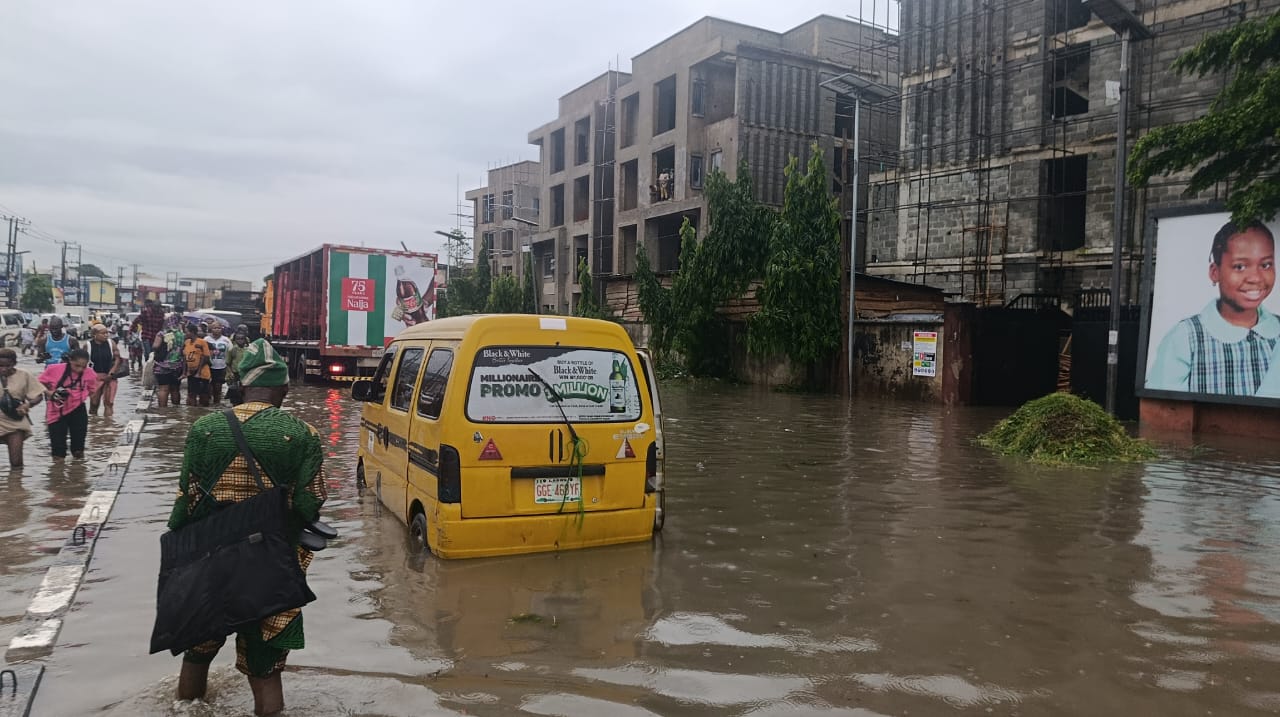
Many residents of Lagos State are counting their losses after days of heavy rainfall triggered widespread flooding that submerged homes, destroyed businesses, displaced families and disrupted daily activities across several parts of the state.
Residents who spoke with the News Agency of Nigeria (NAN) on Friday described the devastating impact of the flood, saying it wiped out sources of livelihood, damaged valuable property and left many households struggling to recover.
One of the hardest-hit victims, a poultry farmer identified as Mr. Alex, who resides in Lekki Scheme II, said floodwaters trapped him inside his residence for three consecutive days while destroying his poultry business.
“For over three days, I couldn’t go out. I’m on my bed right now because everywhere is flooded,” he said.
According to Alex, the rising water completely overwhelmed his poultry pens, killing several chicks and inflicting severe financial losses on his business.
“I’m looking at my chickens dying. I’ve never experienced anything like this before. The eggs I managed to recover, I boiled them to eat,” he lamented.
Having lived in Lekki Scheme II for over a decade, Alex said the community had never witnessed flooding of such magnitude.
He blamed the disaster on poor drainage infrastructure, alleging that some property developers built structures over a major canal, thereby restricting the natural flow of stormwater.
“Those developers built on top of the canal. They narrowed it and turned it into a gutter. That’s why we’re suffering this flood,” he said.
He appealed to the government to expedite work on the ongoing canal project to prevent similar incidents in the future.
Another resident, Mr. Johnson of Ajiran, Lekki, narrated how floodwaters entered his apartment around 4:00 a.m., forcing his family to evacuate to a neighbour’s upstairs residence.
“We had to wake the children and move them to safety because the water kept rising. We have not slept properly since then,” he said.
Johnson disclosed that the flood destroyed several household items, including a refrigerator, electronics, mattresses, food supplies and his children’s educational materials.
Although flooding has become a recurring challenge during the rainy season, he described this year’s experience as one of the worst in the area.
“I couldn’t go to work, and my children could not go to school. It means lost income and missed classes,” he added.
He also expressed concern over the likelihood of outbreaks of waterborne diseases and increased mosquito infestation following the flooding.
At Ikotun Market, foodstuff trader Mrs. Ifeanyi Kugbala said floodwaters invaded her shop and soaked several bags of rice, beans and other food items worth hundreds of thousands of naira.
“When the rain started, water entered my shop without notice. Many of my goods were soaked, and some cannot be sold again,” she said.
Kugbala explained that she had recently borrowed money to restock her business and now feared she might struggle to repay the loan because of the losses.
“This is my only source of income. I don’t know where to start because everything I invested is now at risk,” she said.
She attributed the recurring flooding around the market to blocked drainage systems and appealed to the government to improve drainage facilities while ensuring regular desilting exercises.
In Ebute Metta, another resident, Ms. Kehinde, who lives on Bola Street beside a canal, said heavy rainfall has become a constant source of anxiety for residents.
“Once it starts raining heavily, nobody in this area sleeps with both eyes closed. We keep watching the canal because once it begins to overflow, we know water will soon enter our homes,” she said.
She explained that Friday’s rainfall caused the nearby canal to overflow within a short period, flooding streets and residential compounds.
“We don’t pray for rain anymore; we pray that whenever it rains, the canal doesn’t overflow. That is the reality here,” she said.
Kehinde called on the Lagos State Government to intensify the continuous desilting of canals and expand drainage infrastructure in communities vulnerable to flooding.
A journalist, who requested anonymity, also revealed that he and his family had been living in a hotel for the past two weeks after floodwaters rendered their apartment uninhabitable.
He said the experience had compelled him to search for a new residence and advised prospective tenants to investigate the flood history of any neighbourhood before renting property, particularly during the rainy season.
Many residents blamed the persistent flooding on clogged drainage channels, indiscriminate waste disposal and rapid urban development that has failed to provide adequate drainage infrastructure.
They urged the Lagos State Government to intensify drainage maintenance, enforce environmental sanitation laws and provide emergency relief materials, including food, clean drinking water, mattresses and medical support, to families affected by the floods.