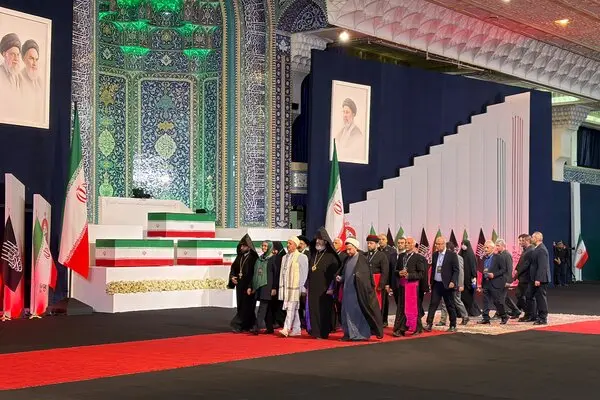
Iran officially commenced funeral ceremonies for its late Supreme Leader, Ali Khamenei, on Saturday as thousands of mourners gathered in Tehran for the first of several events marking the final farewell to the Islamic Republic’s longest-serving leader.
State television confirmed the beginning of the ceremonies, which Iranian authorities say are expected to attract between 15 and 20 million participants in the capital over the next three days in what is being projected as a demonstration of national unity and resilience.
The six-day funeral programme honours Khamenei, who led Iran from 1989 until his death at the age of 86 during the opening phase of the US-Israel conflict with Iran on February 28.
Attention has also focused on the expected appearance of his son and successor, Mojtaba Khamenei, who was appointed Supreme Leader a week after his father’s death but has yet to make a public appearance.
Thousands of mourners carrying red banners, widely recognised in Iran as symbols of vengeance, assembled inside the expansive Grand Mosalla religious complex in Tehran while awaiting the arrival of Khamenei’s coffin.
The atmosphere was marked by chants of “death to America” and “revenge, revenge,” as supporters pledged continued loyalty to the Islamic Republic.
“We came (to the funeral) because we promised the supreme leader we would stand by him to the very end,” 37-year-old university lecturer Reza, who gave only one name, told AFP.
“For a long time, we shouted that we would sacrifice our lives for the leader, but it was he who sacrificed himself for us.”
Another mourner, Javad Akbari, a 43-year-old food-processing worker, said he regretted never meeting Khamenei during his lifetime.
“I never had the chance to see the supreme leader up close, and I regret that. Today, I have come to bid him a final farewell,” he said.
Journalists at the scene observed thousands of people walking long distances to reach the venue, while supporters had begun gathering outside the Grand Mosalla since Friday evening.
“We want to say a final goodbye to our leader, which is why waiting like this isn’t painful or difficult for us,” another mourner, Somayye Hamedi, said.
Authorities have imposed extensive security arrangements across Tehran, closing major roads and expected to shut down the country’s airspace as preparations continue for what is anticipated to become Iran’s largest public event since the funeral of Ayatollah Ruhollah Khomeini in 1989.
Khamenei’s coffin will remain in Tehran until Monday, when it will be carried through the capital in a massive funeral procession.
The remains will then be transported on Tuesday to the religious city of Qom before continuing on Wednesday to several holy sites in neighbouring Iraq that are revered by Shia Muslims.
The funeral journey will conclude on Thursday with his burial in Mashhad, his hometown in northeastern Iran.
Several senior Iranian officials attended Friday’s tribute ceremony, including Parliament Speaker and chief nuclear negotiator Mohammad Bagher Ghalibaf, who became visibly emotional during the proceedings.
Among those present was Ahmad Vahidi, recently appointed commander of the Islamic Revolutionary Guard Corps after his predecessor was killed in the same strikes that claimed Khamenei’s life.
The funeral ceremonies are also expected to provide the first public indication of Mojtaba Khamenei’s condition following reports that he sustained injuries during the attacks, although Iranian authorities have never confirmed the severity of those injuries.
Members of Khamenei’s family who also lost their lives during the conflict, including his infant granddaughter, are expected to be buried during the ceremonies.
Several international dignitaries travelled to Tehran to pay their respects, including Pakistani Prime Minister Shehbaz Sharif and former Russian President Dmitry Medvedev, who represented President Vladimir Putin.
Representatives of Hamas, Hezbollah and Afghanistan’s Taliban government also attended the tribute events.
Although fighting between Iran and the United States has paused following a preliminary agreement reached after five weeks of conflict, Iranian officials maintained that the country remains prepared to resume hostilities if necessary.
“The nation’s call for vengeance must ring in the ears of the whole world,” Ghalibaf declared while encouraging citizens to participate in the funeral.
Iran’s Army Chief, Amir Hatami, also warned that Israel and the United States would “pay for the blood of the martyred leader and all the nation’s martyrs.
Authorities have nevertheless prioritised public safety, introducing crowd-control measures to prevent stampedes similar to those experienced during previous large-scale funerals.
State television broadcast safety guidelines for attendees, while water tankers were deployed across Tehran to spray roads and reduce temperatures expected to exceed 35 degrees Celsius during the ceremonies.
Ahead of Saturday’s events, AFP correspondents noted unusually quiet streets across Tehran, with the city’s normally congested roads largely free of traffic as residents converged on the funeral venues.