Fresh negotiations between the United States and Iran commenced in Switzerland on Sunday, marking the first round of talks since both countries signed a preliminary agreement aimed at ending their recent conflict. However, ongoing hostilities involving Lebanon continue to cast uncertainty over the durability of the arrangement.
Washington and Tehran reached a memorandum of understanding earlier this month to prolong the ceasefire that followed a regional conflict that erupted in late February. The agreement was designed to create a pathway for broader diplomatic discussions on key issues affecting the Middle East.
One of the central components of the understanding involved halting hostilities between Israel and Hezbollah in Lebanon. Despite that commitment, tensions have persisted, with Iran announcing a renewed closure of the Strait of Hormuz in response to Israeli military operations in southern Lebanon. No new attacks were reported in Lebanon after Saturday evening.
The American delegation is being led by Vice President JD Vance, who arrived at the Swiss resort town of Burgenstock to meet Iranian representatives. The meeting marks the second direct engagement between both sides since months of conflict disrupted stability across the region and unsettled global markets.
Speaking before his departure from Joint Base Andrews, Vance said, “I think we’re going to hopefully make progress on the nuclear issue, make progress on the Lebanon ceasefire issue. Those are the two big things that I think we’re to be focused on.”
Swiss authorities confirmed the presence of American and Iranian delegations, as well as mediators from Pakistan and Qatar, at the luxury resort where discussions were scheduled to begin later in the day.
The negotiations are expected to launch a two-month diplomatic process intended to define the framework of a final agreement between the two longtime adversaries. Key issues on the agenda include Iran’s nuclear programme and economic sanctions imposed on Tehran.
Despite the diplomatic efforts, skepticism remains within Iran. Mohsen Rezaei, a senior military adviser to Iran’s leadership, expressed doubts about the reliability of the agreement in a post on social media.
“The enemy has shown itself to be a promise-breaker,” he wrote.
“One should be cautious; any optimism will be exploited by the enemy.”
Iran Demands Full Compliance
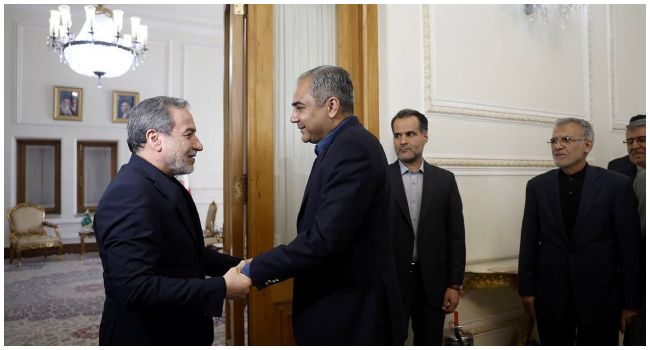
An Iranian delegation headed by Mohammad Bagher Ghalibaf and Foreign Minister Abbas Araghchi arrived in Switzerland late Saturday. Pakistani mediators joined the process on Sunday.
Iran’s Foreign Ministry spokesman, Esmaeil Baqaei, said Tehran would insist that all commitments made under the agreement be honoured.
“Demand implementation of the other party’s commitments,” he stated, warning that failure to do so could jeopardize the entire arrangement.
Pakistan announced that Prime Minister Shehbaz Sharif and Army Chief Asim Munir would participate alongside Qatari mediators.
Meanwhile, American negotiators Jared Kushner and Steve Witkoff have reportedly been working in Switzerland on technical aspects of the discussions. Vance told Fox News that early reports from the team suggested positive progress.
The talks had originally been scheduled to begin on Friday but were delayed after Israel launched airstrikes in Lebanon following the deaths of four Israeli soldiers.
Although Washington later announced a renewed ceasefire, fighting resumed shortly afterward, with both Israel and Hezbollah accusing one another of violating the truce.
Strait of Hormuz Closure Raises Concerns
Citing what it described as a breach of commitments by the United States and continued violations of the Lebanon ceasefire by Israel, Iran’s military command announced the closure of the Strait of Hormuz to maritime traffic.
The strategic waterway serves as one of the world’s most important routes for oil and gas transportation. Previous restrictions imposed during the conflict contributed to volatility in global energy markets.
However, the United States Central Command maintained that safe navigation through the international waterway remained unaffected despite Tehran’s announcement.
Lebanon Remains a Flashpoint
The situation in Lebanon continues to challenge diplomatic efforts. On Saturday, both Israel and Hezbollah traded accusations as clashes persisted in southern parts of the country.
The Israeli military confirmed the death of another soldier during combat operations, bringing the number of Israeli military fatalities since the agreement was reached to five.
An Israeli military official later stated that forces had been instructed to cease offensive operations and would operate only in a defensive capacity within designated security zones.
Hezbollah, however, accused Israeli forces of attempting to infiltrate areas near the Ali Taher hills under the protection of the ceasefire.
Lebanese state media reported Israeli strikes across approximately 20 locations, while authorities said the death toll from the latest violence exceeded 30. According to the Lebanese Health Ministry, more than 4,000 people have been killed since the conflict escalated.
Hezbollah entered the broader regional conflict in March after launching rockets into Israel following the killing of Iran’s supreme leader during joint US-Israeli military operations.
A previous ceasefire announced in April failed to hold, with both sides repeatedly citing alleged violations as justification for continued military action.