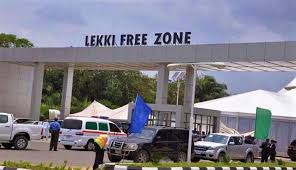
From Rotimi Asher, Lagos
Lekki Free Trade Zone has recorded growth in its office market, with completed stock rising to 23,182 square metres, alongside an additional 45,100 square metres currently in the development pipeline.
The disclosure was contained in a recent Estate Intel report, ETF, titled The Future of Workspaces in Lekki Free Trade Zone, which highlights a gradual shift from a purely industrial base to a more mixed-use business environment.
The report showed that, alongside manufacturing and logistics activities, the corridor is increasingly attracting office developments that support administrative, operational, and service functions.
The zone, which spans parts of Ibeju-Lekki and Epe, continues to position itself as a long-term industrial and commercial hub in Lagos.
The report noted that the Lekki Free Trade Zone, traditionally driven by industrial and logistics activities, is gradually evolving into a mixed-use business environment where office developments are becoming more prominent.
“Estate Intel has recently noticed an increase in the development of office spaces within the Free Trade Zone. Estate Intel’s data shows that approximately 23,182 sqm of office space has been completed, while more than 45,100 sqm remains in the development pipeline”, the report read in part.
It explained that demand is increasingly driven by companies within the zone that require proximity-based administrative and support functions rather than standalone headquarters.
Logistics operators, manufacturers, and service providers are leading this trend as firms seek efficiency by locating back-office operations closer to production and distribution hubs.
The report added that this clustering effect is expected to attract professional services firms, including legal, financial, and consultancy outfits, over time.
Although the zone remains largely industrial, the expanding pipeline signals an early structural shift, with developers positioning ahead of long-term demand linked to ports, manufacturing, and logistics growth.
Several projects highlight the growing office footprint within the Lekki Free Trade Zone corridor.
A notable completed development is Irele Tower in the Lagos Free Zone, a Grade B+ mixed-use project offering about 8,500 square metres of office and retail space. Developed by Tolaram Group, it includes retail outlets, CCTV surveillance, access control systems, and a rooftop cafeteria.
In Alaro City, Lekton Towers is a proposed mixed-use development with about 5,600 square metres of leasable space, combining office, residential, and retail uses.
Also in Alaro City, the proposed Shamballa development is the largest pipeline project, with about 39,500 square metres of Grade A+ office space. It is expected to include conference facilities, retail areas, parking, and sustainability features such as LEED Platinum certification and net-zero operations.
Additionally, the Lekki Free Zone Development Company completed a 10,013-square-metre office and retail project in late 2025, further expanding the corridor’s commercial stock.
Beyond the Lekki Free Trade Zone, Lagos is projected to add 94,931 square metres of prime office space between 2025 and 2027 across ten developments, according to Knight Frank’s Lagos Market Update H2 2024.
Of this, 77,570 square metres is expected in 2025, while 17,361 square metres is due in 2027.
Major projects in Ikoyi include Ulesh Ikoyi (16,390sqm), Dangote Industries HQ (17,000sqm), and The Pantheon (8,160sqm), among others. In Victoria Island, Harbour Point Towers (20,000sqm) leads, while Ikeja’s The Phoenix (8,000sqm) adds to supply.
Knight Frank’s Africa Offices Market Dashboard H1 2025 noted completed schemes such as Pantheon Tower and Phoenix Office Park, contributing to Lagos’ premium office stock.
Lagos retained its position as Africa’s most expensive prime office market at $55 per square metre per month in H1 2025, ahead of Abuja, Cairo, and Lusaka.
Occupancy in prime Lagos offices improved, with Ikoyi rising to 91% in H1 2025, while overall prime occupancy increased to 73%. Hybrid work adoption stood at 31%, though most firms still required full on-site attendance. Rents eased slightly from $56 to $55 per square metre, reflecting a focus on occupancy retention.