By Florence Allor
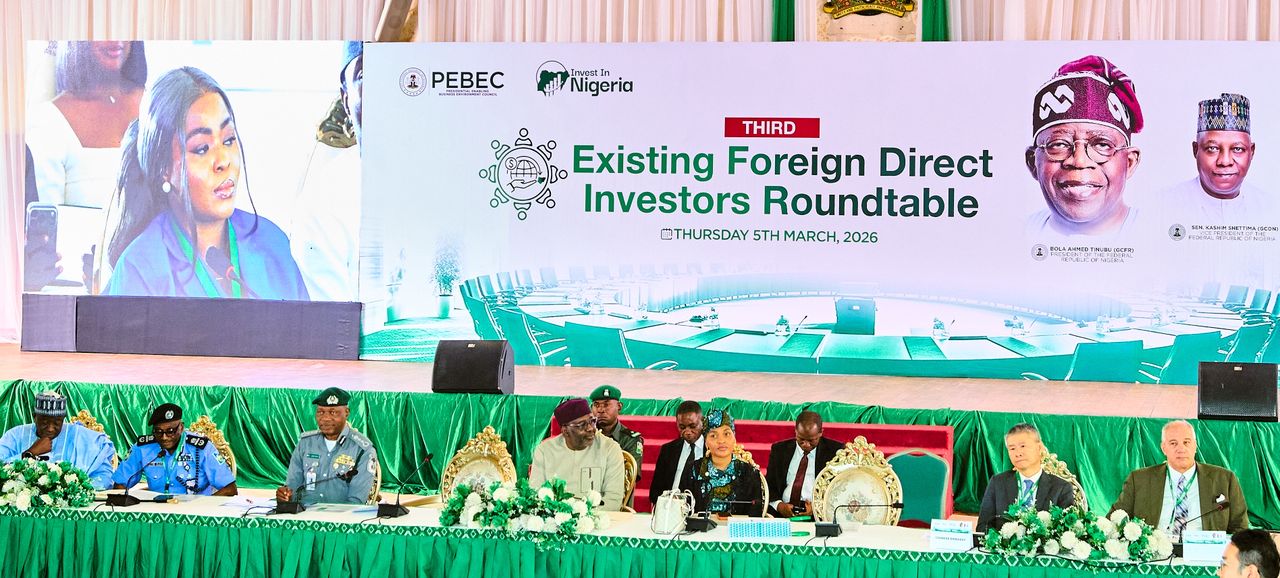
The Presidential Enabling Business Environment Council, PEBEC, on Thursday convened the Third Existing Foreign Direct Investors, FDI, Roundtable at the Banquet Hall of the Presidential Villa, Abuja, bringing together senior government officials and leading foreign investors for dialogue aimed at strengthening Nigeria’s investment climate.
The high-level meeting, held on March 5, formed part of the council’s continuing efforts to deepen collaboration between the government and the private sector while ensuring that ongoing reforms translate into measurable improvements in the operating environment for investors.
Opening the session, Deputy Chief of Staff to the President, Senator Ibrahim Hadejia, welcomed participants on behalf of the Vice President of the Federal Republic of Nigeria and Chairman of PEBEC. He reaffirmed the Federal Government’s commitment to building a stable, transparent and competitive business environment capable of supporting investment expansion and long-term economic growth.
Hadejia noted that sustained engagement with investors remained critical to the government’s broader strategy of improving the ease of doing business in Nigeria and strengthening investor confidence.
In her remarks, the Director-General of PEBEC, Princess Zahrah Mustapha Audu, set the context for the meeting, emphasising the council’s commitment to maintaining consistent dialogue with investors while ensuring coordinated implementation of reforms across government institutions.
She described existing foreign investors as critical partners in Nigeria’s economic development, citing their contributions to job creation, capital inflow, technology transfer and the development of supply chains across key sectors of the economy.
According to her, PEBEC’s engagement strategy places significant emphasis on listening to investors already operating within the country and addressing practical challenges affecting their business operations.
“The feedback from investors provides valuable insight that helps guide policy adjustments and institutional reforms aimed at improving the business environment,” she said.
The roundtable featured presentations and interactive discussions with senior government officials responsible for regulatory and policy frameworks affecting investors.
Among those who made presentations were the Executive Chairman of the Nigeria Revenue Service, Dr Zacch Adedeji; the Comptroller-General of the Nigeria Customs Service, Bashir Adewale Adeniyi, MFR; and the Inspector-General of Police, IGP Olutunji Rilwan Disu.
Also participating virtually was Mr Taiwo Oyedele, Chairman of the Presidential Committee on Fiscal Policy and Tax Reforms and Minister of State for Finance (Designate). In his remarks, Oyedele provided insights into ongoing fiscal and tax reform initiatives designed to improve tax certainty, strengthen revenue administration and enhance Nigeria’s competitiveness as an investment destination.
The event also attracted representatives from several diplomatic missions, including the embassies of the United States, the Russian Federation, France, Colombia, Denmark and Pakistan.
Development partners such as the United Nations and the World Bank were also in attendance, contributing perspectives and technical expertise that enriched discussions on Nigeria’s business and regulatory landscape.
Deliberations during the roundtable were described as robust and highly engaging, with investors raising technical questions and sharing practical insights on issues ranging from security concerns and tax administration to customs procedures and fiscal policy reforms.
The interactive format enabled direct engagement between investors and policymakers, providing clarity on ongoing reforms and identifying areas where further improvements may be required.
Participants commended the Federal Government for creating an open platform for dialogue and expressed strong interest in sustaining regular engagements of this nature.
Observers at the meeting noted that such interactions are critical in fostering trust between government institutions and the investment community while ensuring that policy reforms reflect the practical realities faced by businesses operating in the country.
The discussions also highlighted the importance of sustained public-private sector collaboration in driving reforms that enhance investor confidence and support economic growth.
PEBEC noted that the successful convening of the third edition of the Existing FDI Roundtable further reinforces its role as a key institutional platform for coordinating reforms, addressing investor concerns and strengthening Nigeria’s position as a competitive investment destination in Africa.
The council reiterated its commitment to continuing engagements with both domestic and international investors as part of broader efforts to improve Nigeria’s business environment and attract sustainable investment into the country’s economy.