
By Paul Effiong, Abuja
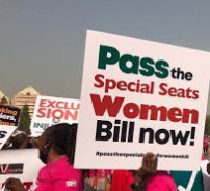
Coalition of Women’s Rights Organisations yesterday staged a peaceful rally at the National Assembly, calling on the lawmakers to urgently pass the Women Reserved Seats Bill into law.
The demonstrators, drawn from various civil society and advocacy groups, said the proposed law was very crucial toward correcting the persistent underrepresentation of women in Nigeria’s legislative houses.
It would be recalled that the Women Reserved Seats Bill is among 44 priority constitutional amendment proposals currently awaiting final voting by the National Assembly of Nigeria.
The expected legislation seeks to amend the nation’s constitution to create reserved seats for women in both the National and state Assemblies.
Proponents of the Bil say the measure was intended as a temporary intervention to boost women’s political participation by establishing special constituencies exclusively contested by female candidates.
Speaking during the rally, former convener of the Nigeria Civil Society Situation Room, Ene Obi applauded lawmakers for the progress made so far on the bill but emphasized the need for urgency specially as 2027 general election is near.
She explained that “a vote for a woman is a vote for life. Women are the hope of life”.
Obi, who is also a human right activist, emphasise that the gathering was a peaceful rally but not a protest.
Speaking further on the need to push for the Bill, Obi observed that participants at the rally had been very civil and orderly while waiting for lawmakers to address them.
The civil society groups appealed to the Assembly to act swiftly to allow women to contest the proposed seats in 2027.
Meanwhile, an interest group, Reserved Seats for Women Bill Campaign Coalition, has called for immediate and decisive legislative action to ensure passage of the bill by the National Assembly.
The Communications Lead of the coalition, Mr Hammed Adejare, made the call in a statement yesterday in Abuja.
Adejare stated that since the Independent National Electoral Commission ,INEC, had officially released the 2027 general election timetable, there was the need for immediate legislative action to ensure the passage of the bill.
According to him, this is critical to securing inclusive political representation in the country.
He noted that Nigeria had continued to record one of the lowest levels of female parliamentary representation globally, with women occupying less than five per cent of seats in the national assembly.
Adejare said this this ‘enduring imbalance’ was not merely statistics, but reflected structural barriers that weakened representative governance and eroded public confidence in democratic institutions.
He described the Reserved Seats for Women bill as a time-bound corrective mechanism designed to operate for an initial period of 16 years.
The communications lead added that the bill would accelerate progress toward balanced representation, while preserving the integrity and competitiveness of Nigeria’s electoral system.
“It is measured, constitutional and aligns with democratic best practice. Women across Nigeria’s 36 states are prepared to contest, lead and serve.
“The question before the nation is whether the 469 lawmakers of the 10th National Assembly are prepared to act with urgency and responsibility to remove systemic barriers that have constrained women’s participation for decades”, he said.
Adejare, therefore, urged the leadership of the National Assembly to prioritise and fast-track the passage of the bill within the remaining legislative timeframe.
He added that Nigeria must not approach the 2027 general elections with the same structural inequities that had long limited women’s full and equal participation in the democratic process.
“The moment for reform is now. The electoral clock is ticking. The publication of the electoral calendar provided clarity for political parties, candidates, institutions and citizens.
“It also underscores a critical reality: the legislative window to conclude consideration of House Bill 1349 and Senate Bill 550.
“The proposed constitutional amendment to establish 182 reserved seats for women across the Senate, the House of Representatives and the State Houses of Assembly is rapidly narrowing”, he said.
The bill, also known as House Bill 1349, in the House of Representatives seeks to amend the 1999 Constitution to establish reserved seats for women in both the National Assembly and State Houses of Assembly.
It aims to address the under-representation of women in legislative bodies by creating special constituencies exclusively contested by women.
The bill, if passed by the national assembly and assented to by the president, is expected to serve as a temporary measure to promote women’s political involvement, with a review after four general election cycles to determine its future.
However, the National Assembly, yesterday, pledged to consider the Special Seats Bill currently before it, following sustained advocacy by Nigerian women groups.
Spokesman, House of Representatives, Honourable Akin Rotimi Jr., who represents Ekiti North, gave the assurance while addressing protesting women at the entrance of the National Assembly Complex.
Rotimi said the proposed legislation was gathering momentum, noting that Speaker Tajudeen Abbas and Deputy Speaker Benjamin Kalu had endorsed the constitutional amendment promoting women’s inclusion.
“The low level of representation of women in the National Assembly is something that is important to both men and women.
“We have so many men and women in the assembly who believe that having 14 women out of 360 in the House of Representatives is a gross injustice, and having four women out of 109 in the Senate is a gross injustice.
“Having over 20 plus seats in some of the state houses of assembly that don’t have a single woman is a gross injustice.
“So I want you to know that we have heard you, we have listened to you, and this has been reflected in the Constitutional Amendment Bills that are currently before the National Assembly”, he said.
Rotimi disclosed that approximately 40 constitutional amendment bills were before the National Assembly and would be subjected to a vote by lawmakers in the coming weeks.
“I can assure you that your advocacy has been listened to. But it is also important that you reach out to your members and your senators to impress it upon them that this is what you want.”
He added that the constitutional amendment bills would be voted on electronically, stressing that lawmakers had tested the technology to ensure seamless and transparent operation.
According to him, voting electronically will ensure every member’s and senator’s vote is publicly known.
“This is a bill that I believe Mr President would pass if it gets to him. As you know, our excellency, the first lady, a former senator, has also been advocating for this bill.
“So I’m here basically to let you know that we hear you, and we’re going to take that feedback to the members and the leadership of the NASS”.
According to him, once deliberations on the Electoral Act Amendments are concluded, lawmakers will proceed to vote on the 40 constitutional amendment bills, including the reserved seats proposal.
Earlier, one of the leaders of the protesting women, Ene Obe, who identified herself as a Nigerian citizen, said the women were at NASS to remind them of the importance of the bill.
Obe noted that democracy and fair representation go hand in hand, stressing that there would be increased economic growth when more women are included in governance.
Also, Mrs Ebere Ifendu, Chairperson, Women Political Participation Working Group, stated that the Special Seat Bill was also as important as the Electoral Act.
“We want you to consider this bill alongside the Electoral Act because it is also critical to the 2027 General Elections.
“The idea is to ensure that more women participate in the 2027 General Elections. It has to do with electoral integrity.”
Speaking further, Country Director of ActionAid, Mr Andrew Mamedu, noted that women’s representation in Nigerian politics had been on a decline.
He added that women ought not to be begging for the passage of the bill, adding that it was their right as citizens of Nigeria.
He called on the All Progressives Congress ,APC, to step up, noting that under the Peoples Democratic Party ,PDP, more women were included in governance.
Different women groups, including International Federation of Women Lawyers, FIDA, Nigeria Association of Women Journalists, NAWOJ, and African Women Lawyers Association, AWLA, among others, were present at the rally.