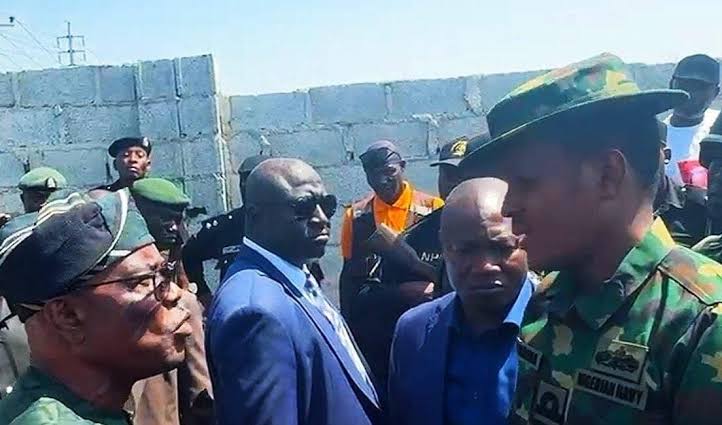
Dust raised by the altercation between the Minister of the Federal Capital Territory, FCT, Nyesom Wike, and a naval officer in Abuja a few days ago is yet to settle, as a former Chief of Defence Staff, CDS, General Lucky Irabor and the Minister of State for Defence, Bello Matawalle, yesterday, warned that any act of disrespect towards the uniformed services amounts to an affront on the authority of the Nigerian state.
The minister dismissed any justification for disciplining Lieutenant A. Yerima, the naval officer involved in the fracas, describing the encounter as “unnecessary and avoidable.”
However, Wike yesterday debunked social media reports suggesting a personal beef with the military, insisting that he would not succumb to intimidation.
In a keynote address at the National Dialogue on Media, Terrorism and National Security at the 21st All Nigeria Editors Conference, ANEC, 2025, in Abuja, General Irabor said uniforms worn by military or security personnel go beyond the individual, stressing that they symbolise the power, dignity and sovereignty of the nation.
“The uniform is not about who is wearing it; it represents the authority of the state. Whether it is a young officer or a senior one, when you make disparaging remarks or act against them, you are, in fact, insulting the state itself.”
Irabor, who led the armed forces from 2021-2023, described the public reactions to the FCT minister’s encounter with the officer as “largely misguided,” adding that many commentators had “missed the real issue.”
He reminded citizens that the military operates under strict codes of conduct, adding that no one, not even a General, had the right to physically assault or publicly humiliate a subordinate.
“Even as a General, I cannot slap my soldier. If I do, I will face disciplinary action. There are laid-down mechanisms for addressing misconduct and that is what distinguishes a state governed by law from a jungle, “he added.
Drawing from legal principles, the retired General explained that every offence must be viewed through two lenses , actus reus (the act itself) and mens rea (the intent behind it).
He said while the FCT minister had authority over land matters, the heart of the controversy lies in the respect owed to state authority as embodied by uniformed officers.
Calling for restraint and respect in dealing with uniformed personnel, Irabor said the rule of law provides channels for redress if a soldier or police officer err.
“If the person in uniform misuses his authority, he will be dealt with, but the uniform itself must be respected. That is what sustains order in a civilised society,” he added.
On his part, the minister of state for defence dismissed any justification for disciplining Lieutenant Yerima.
Speaking in an interview with DCL Hausa on Wednesday, Matawalle said the incident should have been handled through formal communication, rather than a public altercation.
“What happened between Minister Wike and the officer is unfortunate. When he got there, the officer explained that he was simply obeying orders given to him. Wike should not have exchanged words with the officer; he ought to have addressed his concerns through the officer’s superiors,” the minister said.
According to him, the naval officer conducted himself professionally and acted strictly under orders, maintaining composure throughout the encounter.
“He (Wike) is our colleague and could have reached out to us to resolve whatever issue. The officer’s action was lawful because he was trained to be disciplined, loyal and obedient to orders. Therefore, he only carried out his duty worthy of commendation,” he stated.
The minister clarified that the officer’s actions did not breach any military code of conduct.
“He did not commit any offence under military regulations; he merely obeyed a lawful order and followed due process. If you observe carefully, he spoke respectfully and conducted himself properly,” Matawalle added.
He cautioned public officials against undermining the authority of the armed forces, noting that disrespecting men in uniform indirectly challenges the authority of the commander-in-chief.
“There is no offence under military law for which he should be charged. Wike should not have engaged him in an altercation, especially out of respect for the uniform he was wearing.
‘’Anyone who disrespects a soldier indirectly disrespects the president, who is the commander-in-chief of the Armed Forces. There is, therefore, no basis for any punishment against the officer,” he said.