By Blessing Otobong-Gabriel
Captain Umar Abubakar (Retired), the Commandant General of the Vigilante Group of Nigeria (VGN), has called on the federal government to formally recognize and support the efforts of the organization in the ongoing fight against insecurity across the country.
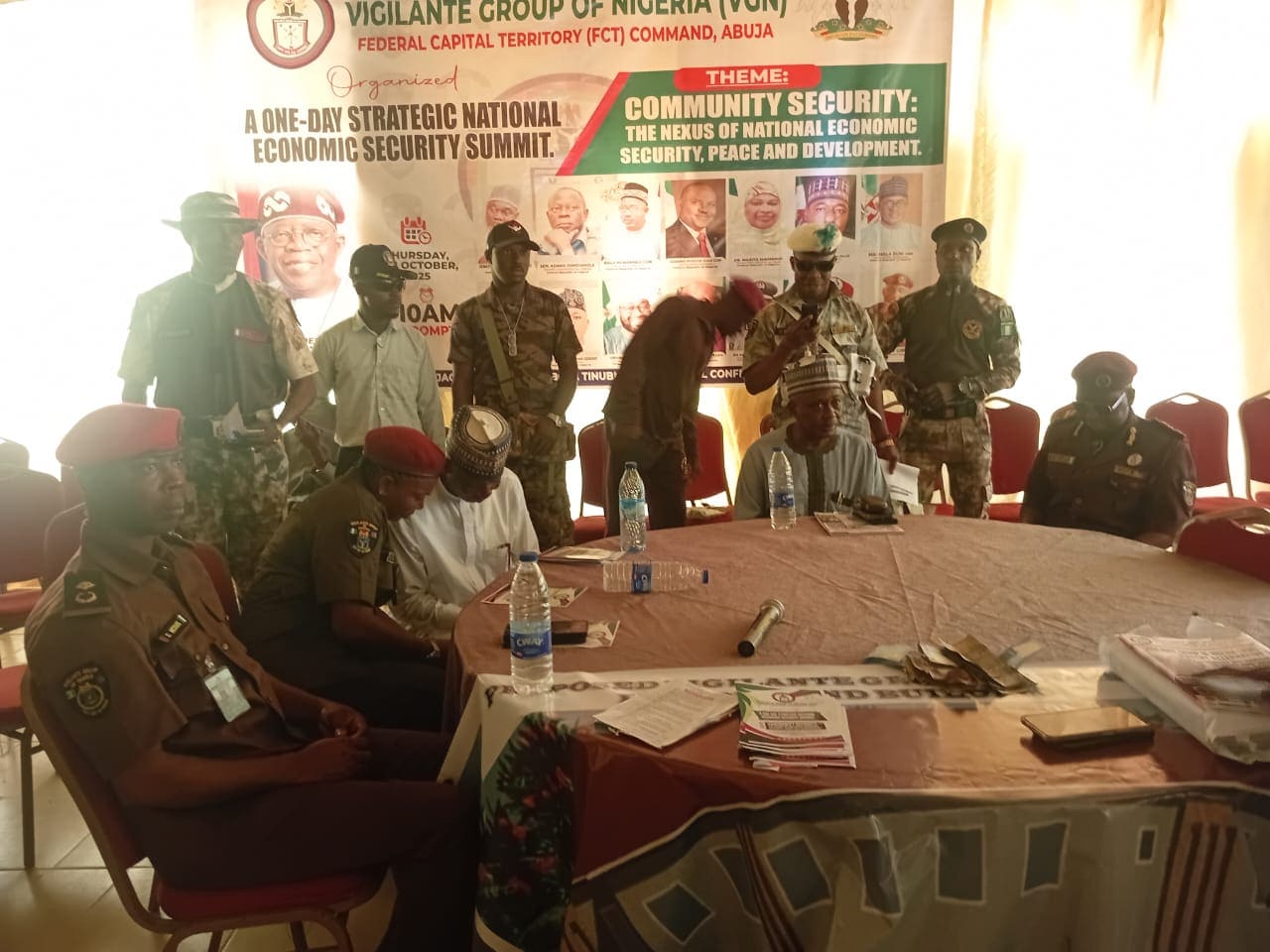
Speaking during a one day strategic national economic security summit on Thursday, Captain Abubakar emphasized the dedication and passion of his team, noting that although members of the group are unpaid volunteers, they remain committed to protecting Nigerian communities from banditry and violent crime.
“We’re not lazy; we’re passionate about security,” he said. “We don’t want to sit idly by while bandits terrorize our communities. Even without pay, we work tirelessly to keep our country safe.”
The retired naval officer pointed out that while the number of active bandits across Nigeria is unlikely to exceed 100,000, the Vigilante Group of Nigeria boasts a strength of over one million members nationwide.
“If given the opportunity, we can face them and neutralize the threat,” he declared.
“We lead from the front—we don’t wait for the police or the army. In fact, the military understands our role and has worked with us on several occasions.”
Captain Abubakar also addressed the systemic challenges facing many of the group’s members, revealing that numerous volunteers had attempted to join formal security agencies like the police or army but were turned away due to lack of political connections or nepotism.
“Many of us were rejected—not because we lack the passion or ability, but because we don’t have the right connections. We have the guts, the drive, and the local knowledge. All we ask for is a chance to serve.”
Despite his retirement from the Navy, Abubakar stressed that he remains physically fit and emotionally driven to contribute to national security.
He noted that the Vigilante Group of Nigeria is fully registered with the Corporate Affairs Commission (CAC) and operates within legal boundaries. He urged the government to extend official recognition and institutional support to the group, adding that their work complements the efforts of conventional security forces.
“We’re not asking for handouts—we’re asking for support and collaboration. Our goal is to restore normalcy and return Nigeria to the glory days of peace and security.”
The Commander General, said “as the first line of defense, we live among the communities we protect, giving us unmatched insight into local terrain, language, and daily life. When threats arise, we’re often the first to detect them. Our focus should be on safeguarding real targets—markets, schools, streets, places of worship, and business centers—where ordinary people live and work, not just high-security government zones.
“Our strength lies in our numbers—over a million strong—surpassing any other security agency in the country. We don’t need advanced technology; our greatest asset is our deep connection to the communities we serve. While some say we aren’t compensated, I believe our reward comes from a higher source—for every act of protection, we are paid by God Almighty”.
Also, Oba Doctor Olu Adeoye, Ilude Village One Chairman of Non-Indigenes in the Federal Capital Territory (FCT), and Chairman of Obas of Yoruba in the FCT, stated that he has been actively engaging with key stakeholders, including the Police Commissioner in Abuja and the Honorable Minister of the FCT, Nyesom Wike.
He added that meetings have been held with non-indigenes and national leaders to address the growing security challenges, particularly those involving kidnappers and thugs. “We’ve agreed to work together to flush them out,” he said.
“Our program is already in motion, and by tomorrow, we’ll be holding a strategic meeting at the villa,” he continued. “While these security challenges are not unique to the FCT, we are determined to find lasting solutions. With our strategies in place and by God’s grace, I’m confident these issues will soon become a thing of the past.”