The National Economic Council (NEC) has endorsed the Renewed Hope Development Plan (2026–2030), a successor framework to Nigeria’s National Development Plan (2021–2025), with the goal of steering the country towards a $1 trillion economy by 2030.
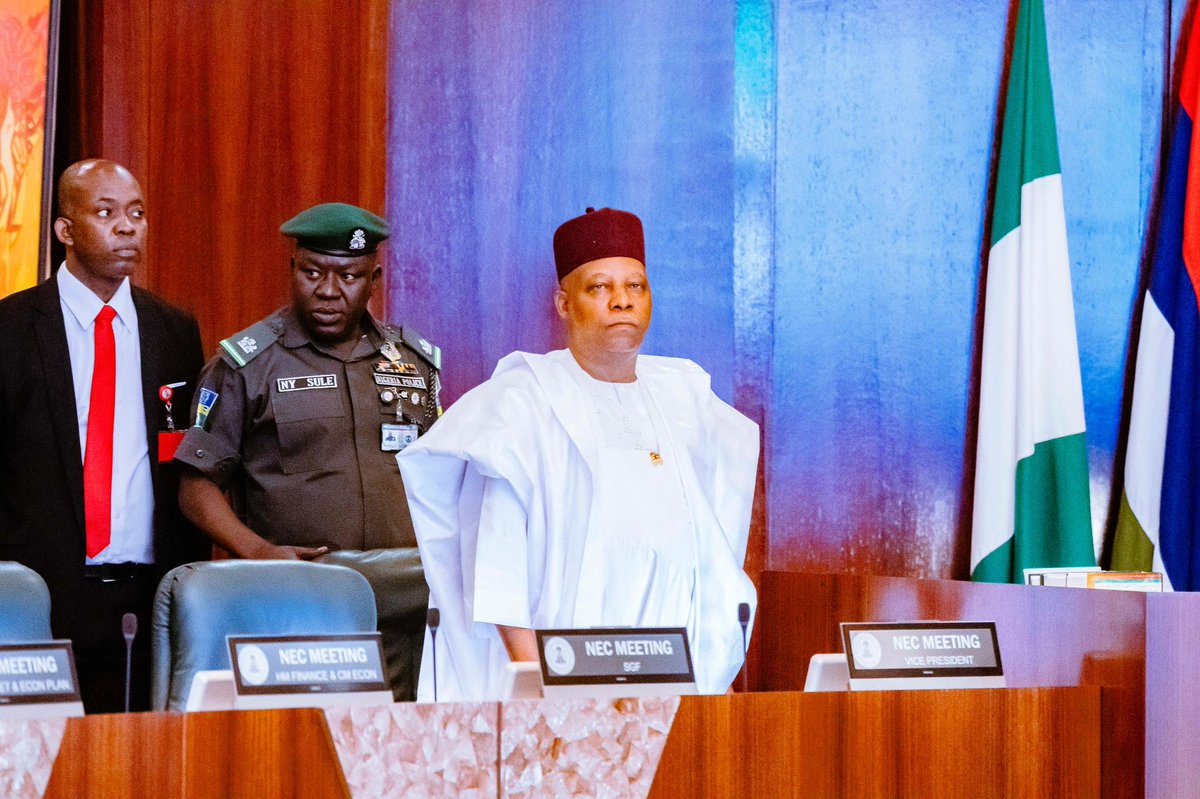
At its 151st meeting chaired by Vice President Kashim Shettima at the Presidential Villa, in Abuja yesterday, the council resolved to adopt the plan as part of President Bola Ahmed Tinubu’s reform agenda and long-term Nigeria Agenda 2050.
Briefing journalists after the meeting, Minister of Budget and Economic Planning, Atiku Bagudu, described the Renewed Hope National Plan as a segment of a broader 30-year development strategy. He said the framework was designed to guarantee inclusivity and accelerate economic growth.
Vice President Shettima explained that the plan is intended to consolidate ongoing reforms and strengthen policy continuity, while ensuring that Nigeria’s growth trajectory aligns with the long-term vision of Nigeria Agenda 2050.
“Another major consideration today is the expiration of the National Development Plan 2021–2025 and the preparation of its successor, the Renewed Hope Plan 2026–2030. This, to us, is no ordinary transition. It is the bridge between lessons learnt and ambitions pursued.
“The Renewed Hope Plan will consolidate ongoing reforms, deepen policy continuity, and align our medium-term strategies with the long-term horizon of Nigeria Agenda 2050. It’s a practical roadmap towards a $1 trillion economy by 2030,” Shettima said.
The Vice President further stressed that the plan would be participatory and not drafted solely in Abuja.
“What is even more crucial is that this plan will not be drawn from the ivory towers of Abuja alone. It will be participatory.
“We are going to keep on engaging state governments, local governments, organised private sector, civil society, labour, youth, and traditional institutions, and the conversation begins here today,” he noted.
Shettima also disclosed progress in the agricultural sector, announcing that NASENI had boosted local production of solar-powered irrigation pumps to cut costs for farmers and expand dry-season cultivation.
“This is the story of the nation’s refusal to be hostage to petrol-powered systems. This is an intervention to lower farmers’ energy costs, expand dry-season farming, and reinforce food security,” he said.
The Vice President reaffirmed NEC’s role as a solution-driven platform, urging members to ensure that policies translate into practical benefits for citizens.
“Distinguished colleagues, you have made sure that this council is not a stage for applause. You are the reason it is a workshop for solutions. Let this 151st meeting echo as a continuation of our covenant.
“Let it be remembered not only for the issues tabled but for the resolve shown. Let it move from chamber to community, from rhetoric to result,” Shettima added.
Beyond economic reforms, NEC also focused on preparations for the upcoming national immunisation campaign. The council directed the Accountant General of the Federation to fast-track release of funds for a smooth exercise, while urging partners to leverage technology to improve surveillance and tracking systems in Nigeria’s routine immunisation programme.