First Lady, Senator Oluremi Tinubu has reaffirmed her commitment to end the spread of tuberculosis, TB, in Nigeria by 2030.
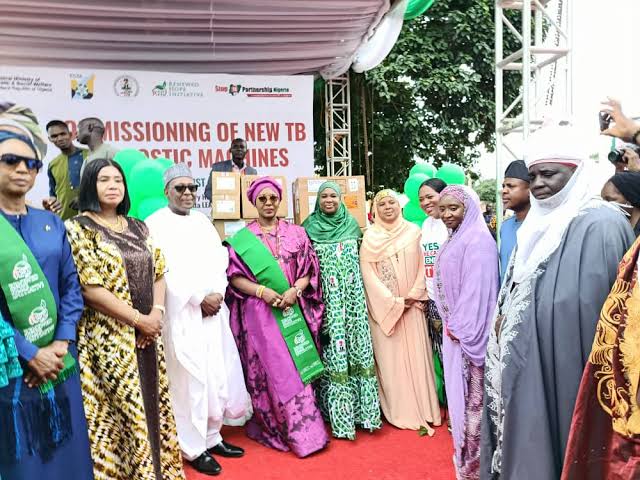
Mrs Tinubu stated this during the official commissioning of new molecular diagnostic machines to improve TB detection and treatment nationwide yesterday in Abuja.
Tinubu, who was represented by the Wife of the Kwara State governor, Olufolake Abdulrazaq, at the commissioning in Bwari, emphasised the significance of the new diagnostic machines.
She said the machines, provided through her Renewed Hope Initiative, RHI, is a direct fulfillment of the additional N1 billion pledge made earlier this year during the World TB Day outreach in Sauka Village, FCT.
“I am pleased to say that this pledge has been translated into reality.
“Tuberculosis is curable, but far too many Nigerians are still dying from the disease, not because there is no technology to detect it, but because access to diagnostic tools is limited,” she said.
She explained that the new machines would be deployed across underserved areas in Nigeria to enable rapid and accurate TB detection, ultimately breaking the chain of transmission and saving lives.
The first lady called for greater domestic resource mobilisation, stressing that ending TB requires more than machines and medication but human, financial, technical and political resources.
“As the global and national champion for TB, I assure you that I will continue to advocate and lead the fight to end TB in Nigeria by 2030,” she said.
Senator Tinubu also lauded the Federal Ministry of Health and Stop TB Partnership Nigeria for their stewardship and accountability, urging all stakeholders to “stand shoulder to shoulder” in the fight against the disease.
“Let us build a Nigeria where no life is lost to tuberculosis, where health is not a privilege but a right, and where our hope is both renewed and fulfilled,” she said.
The Minister of Health and Social Welfare, Professor Muhammad Pate commended the first lady for her leadership, adding that the federal government is working to integrate TB services into the primary health care system, improve diagnostic capacity and incentivise health workers.
“Her Excellency has delivered decisively. She is not just our national TB champion, she is also Africa’s regional champion and a global symbol of commitment to ending TB,” he said.
Pate said in just three months in 2025, over 46 million visits were recorded across primary health care centres, underscoring rising public confidence in the system.
He said the Tinubu administration’s healthcare reforms, backed by state and local governments, the private sector and global partners, are beginning to yield tangible results.
Director of Public Health at the Ministry of Health and Social Welfare, Dr Godwin Ntadom added that with the new diagnostic innovation, test results could now be obtained in less than 30 minutes, as opposed to the previous delay for several days.
“This marks a turning point. The end of TB in the FCT starts today.
“Globally, there are over 11 million new TB cases annually, with about 1.3 million deaths.
“Nigeria accounts for the highest burden in Africa and we detect around 350,000 cases yearly,” he said.
In spite of the availability of free TB treatment, he lamented that high morbidity and mortality persist due to delayed diagnosis and low awareness.
He described the new TB diagnostic facility as a timely intervention that would drastically cut diagnostic delays.
Medical Field Epidemiologist Coordinator for the Federal Capital Territory at the World Health Organisation, WHO, Nigeria, Dr Kumshida Balami said the machines reaffirmed Nigeria’s unwavering resolve to champion innovation, equity and resilient health systems in the fight against tuberculosis.
Balami assured that with a strong political will, community participation and sustained collaboration across all sectors, ending TB in Nigeria is not just a goal, but an achievable reality within our lifetime.
She also called on all partners, government, civil society, communities and the private sector to intensify investments and actions so that no one is left behind in the journey to find, treat and support every person affected by TB. (NAN)