…As Enugu farmers lament crash in prices of rice, garri
By Dickson Pat Abuja and Ngozi Nwatu in Enugu
Federal Government has declared that the era of “briefcase farmers” benefiting from agricultural interventions is over, as it embarks on a comprehensive farmer data audit and registry to identify genuine beneficiaries across the country.
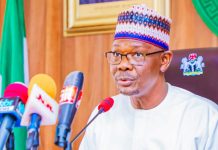
Minister of State for Agriculture and Food Security, Senator Aliyu Sabi Abdullahi, made this known on Wednesday in Kaduna during the technical session of the Government-Citizen Engagement Forum organised by the Sir Ahmadu Bello Memorial Foundation.
He said the President Bola Tinubu-led administration, having inherited a food crisis, rolled out bold, data-driven reforms aimed at reviving agriculture, increasing food production, and ending the culture of elite capture in farming incentives.
“We are ensuring that only genuine farmers benefit from government programmes. No more briefcase farmers”, the Minister said.
He added that the current state of emergency on food security declared by the Tinubu administration was still in full effect, with far-reaching interventions focused on boosting production, stabilising food prices, and ensuring fair distribution of resources.
“Our priority is simple: ramp up production, reduce food prices, and ensure equitable access to support. We met a food crisis and responded with data-backed, targeted actions”, he said.
Abdullahi revealed that under the Agro-Pocket initiative, over 133,000 hectares of wheat had been cultivated across 15 northern states—exceeding the initial target of 130,000 hectares.
He said Jigawa State alone accounts for more than 50,000 hectares.
He also disclosed that another plan had been activated to support 44,500 rice farmers nationwide, with an improved extension service system aimed at addressing the unacceptable extension-to-farmer ratio of 1 to 25,000.
On mechanisation, the Minister announced that 2,000 Belarusian tractors and 9,000 implements had been launched by President Tinubu to modernise farming and enhance productivity across the country.
“Our approach is strategic and modern. These interventions are not cosmetic; they are geared towards making agriculture competitive and attractive again”, Abdullahi said.
He explained that Special Agro-Processing Zones are being developed to support market access and value addition, enabling farmers to earn higher returns.
To boost resilience and productivity, he said agricultural research institutions have been empowered to release improved seed varieties, including new strains of maize, rice, cassava, and tomato resistant to the deadly “tomato ebola” disease.
In the livestock sub-sector, he said government attention has shifted to sustainable development through the creation of grazing reserves, livestock villages, and transit shelters, while a national dairy policy is in the works.
He also revealed that three key dam projects Nwabi Yashin, Nwape, and Amla—had been completed, unlocking over 2,700 hectares of land for irrigation. Plans are underway to concession mini-hydro dams for off-grid power to energize farming communities.
“This is not just about responding to today’s needs. We are laying the foundation for future resilience—reclaiming university farmlands, training youths and women, and reforming agricultural governance structures”, he added.
Abdullahi, therefore, called on Northern stakeholders to confront those who sabotage reforms by manipulating systems and shortchanging real farmers. “We must discredit such people. The time to act is now”, the Minister said.
Meanwhile, Some farmers in Enugu State, Wednesday, called on the federal government to restrict the importation of some food items into Nigeria to save the fortunes of local farmers. According to them, the development had discouraged them from further farming investments.
Cyprian Ajah is a farmer at Okpanku in Aninri Local Government Area of Enugu State. He lamented that his investments in farming had been lost due to the market price crash.
Quoting him, “I cultivated cassava and rice in commercial quantities in Okpanku. But what I thought would be my moments of joy had become agonising. Many farmers are going through the same pains. By this time last year, a 50kg bag of rice was sold at N55, 000. This year, it is N35, 000 only. The same last year, a 100kg bag of rice was around N120, 000. This year, it is N67, 000. For garri, ten cups of garri last year were sold for N2,000. This year, twenty cups of garri go for N2,000.
“In terms of labour, the daily wage for cultivation last year was N3,000; this year, it is N6,000. Daily clearing of weeds this year is N4,000 as against last year’s N1, 500. The cost of herbicides this year is far higher than that of last year. Fertilisers are also expensive. Having spent all these, one had expected that we would make some fortunes during the harvest period. But the reverse has become the case”.
He attributed the development to the federal government’s opening of borders which made foreign food items to flood Nigerian markets.
Ajah said, “The federal government should restrict food importations into Nigeria to enable local farmers to survive this economic crunch. Otherwise, the government should anticipate farmer apathy next year and beyond. We have laboured in vain. The high cost of farming also stemmed from the failure of the government to subsidise agro materials. We expected subsidies in fertilisers, herbicides, and access to agro machinery. We were told to form cooperative societies for easy access to agro incentives. But not much of such incentives got to genuine farmers”.
Obiora Edeh is a cassava farmer at Ikem in Isi-Uzo Local Government Area. He said, “It is discouraging. I cultivated over three hectares of cassava last year. I hired labourers, bought fertilisers, spent a lot on herbicides and so on. I had projected that a bag of garri would be around N30, 000 minimum to enable me to make some gains. The opposite happened. In some cases, a bag goes for N14, 000. The worst is to sell unprocessed cassava tubers. I carried some to the market. The unsold ones were left to rot. What I realised from my farming proceeds this year is far below the cost of labour alone let alone other expenses. The efforts were not worth it”.
Samson Ogbuka hails from Mpu in Aninri LGA. He said, “I really don’t know what to do. Garri processing passes through many stages, all costly. The dilemma is whether to abandon the farm or not. The species of the cassava I planted stays only nine months to mature. The tubers decay if they are allowed to stay beyond nine months. Paying labourers to peel, grind and fry raw cassava to make garri is expensive. I have not considered transportation. If you count all these, one is already counting losses even before the garri is taken to the market for sale. I think farming is no longer worth it. The federal government deceived us”.