…Targets new borrowing to finance appropriation
…NASS extends 2024 budget implementation to June 30, 2025
By Cyril Ogar
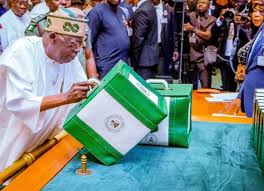
President Bola Tinubu’s administration is banking on an increase in oil revenue to help fund record spending outlined in the 2025 budget that he presented to the lawmakers yesterday.
The government envisions spending N47.9 trillion , $31 billion, and collecting N34.8 trillion of revenue in the fiscal year starting Jan. 1. That leaves a deficit of N13.1 trillion, or about 3.9% of Gross Domestic Product, which the nation will fund by raising debt in local and international markets.
The government forecasts 4.6% growth in gross domestic product next year, which would be the fastest pace in a decade. That’s more optimistic than the 3.2% projected by the International Monetary Fund and the 3.7% anticipated by the African Development Bank. It expects annual inflation to slow to 15% in 2025, from more than 34%.
“This is an ambitious but necessary budget to secure our future”, Tinubu, who has championed an ambitious programme to steady the nation’s finances since taking office in May last year, told lawmakers in Abuja, the Federal capital city.
Tinubu’s reforms, which included devaluation of naira, abolishing complex multiple exchange rate system and scrapping costly gasoline subsidies, have been welcomed by the International Monetary Fund, IMF, and the World Bank, WB. But soaring inflation has led to an increase in the cost of living, worsening the plight of more than half of the population who live below the poverty line.
On the plus side, foreign investment in the oil and gas sector reached more than $5 billion, according to the president. The West African nation is seeking to attract $10 billion in new investments for deep-water gas exploration through tax incentives and other measures.
Nigeria will prioritize human-capital development, Tinubu said, and has allocated record spending to education, health care and other social services. The spending projection includes 15.8 trillion naira for debt-servicing costs.
The government’s revenue targets are based on an oil price of $75 per barrel and output off 2.06 million barrels per day; assumptions some analysts consider overly optimistic given that Nigeria has consistently missed its OPEC production targets in recent years.
The country produced 1.5 million barrels of crude per day last month, according to OPEC. The government has attributed the underperformance to theft, and says new projects are set to lift output. Brent crude oil traded around $73.5 yesterday.
“The reliance on oil revenues remains a major concern”, said Ikemesit Effiong, a partner and head of research at SBM Intelligence. “Volatility in global oil markets and Nigeria’s limited diversification undermine budget reliability. In addition, exchange-rate instability will complicate the allocation of funds and investment planning, which will impact the government’s aspirations to stimulate growth and reduce poverty”.
Tinubu said his administration plans to increase the ratio of revenue relative to GDP and take measures to reduce wasteful spending.
Some of the budget projections, including the oil-production target and pricing, appear to be unrealistic, said Ayodeji Dawodu, director of fixed income at BancTrust & Co. Investment Bank.
“The potential for the deficit to be larger than expected is inflationary in our view and paints a negative picture for the stability of the local currency”, he said. This could be the government’s last chance to rein in the deficit because the next budget will come amid electioneering for the 2027 election, he said.
Meanwhile, Wale Edun, the Minister of Finance and Coordinating Minister for the Economy, has revealed that the N13 trillion deficit in the N48 trillion 2025 budget will be financed through borrowing.
Speaking to journalists after the Federal Executive Council ,FEC, meeting on Monday, December 16, Edun said that the total projected revenue for 2025 is N34.82 trillion, with the projected expenditure set at N47.96 trillion.
This represents a 36.8% increase from the 2024 budget estimates, Tribune reports. PAY
The deficit is projected to be N13.14 trillion, which is 3.89% of the country’s Gross Domestic Product ,GDP.
The finance minister assured Nigerians that the budget was crafted considering the progress made under President Bola Tinubu’s leadership over the past 18 months.
He stressed the importance of fiscal sustainability, noting that governments worldwide, including Nigeria’s, are focused on balancing revenue, expenditure, and borrowing to foster an environment conducive to economic growth.
His words: “Private sector-led economies like ours depend on investors to fund various projects, boost productivity, create jobs, and alleviate poverty.
“The government has implemented policies that ensure market-driven pricing of petroleum products and foreign exchange. Efforts to improve electricity pricing are also underway”.
President Tinubu shifts 2025 budget presentation earlier, AljazirahNigeria reported that President Bola Ahmed Tinubu will not be able to present the 2025 budget to a joint session of the National Assembly on Tuesday, December 17.
Tinubu previously submitted the Medium-Term Expenditure Framework ,MTEF, and Fiscal Strategy Paper ,FSP, for 2025-2027
In a similar vein, the National Assembly has approved an extension of the 2024 Budget’s lifespan to June 2025, ensuring continuity in fiscal operations and the seamless execution of key government projects.
The announcement was made by the President of the Senate, Godswill Akpabio, during the joint sitting of the National Assembly for the presentation of the 2025 budget proposal by President Bola Tinubu.
Senator Akpabio praised President Tinubu for his bold reforms, which have been central to advancing Nigeria’s economic and developmental goals.
Highlighting the Tax Reform Bill, the Nigerian Revenue Service Establishment Bill 2024, and other critical legislative initiatives, he noted that these efforts are essential steps toward the administration’s vision of a prosperous, technologically advanced Nigeria.
The Senate President urged Ministries, Departments, and Agencies ,MDAs, to prioritize their roles in the budget defence process, emphasizing the need for timely submissions and active participation.
He warned that the National Assembly would take decisive action against MDAs that fail to appear for budget defence sessions or cause unnecessary delays.
The extension of the 2024 Budget to mid-2025 is seen as a strategic move to accommodate the government’s ambitious reform agenda and provide flexibility in implementing ongoing projects.
This decision ensures that critical expenditures continue uninterrupted while the 2025 budget undergoes deliberation and approval.
Analysts believe the extension will help the government achieve its economic goals while mitigating challenges posed by delayed project implementation and fiscal bottlenecks.