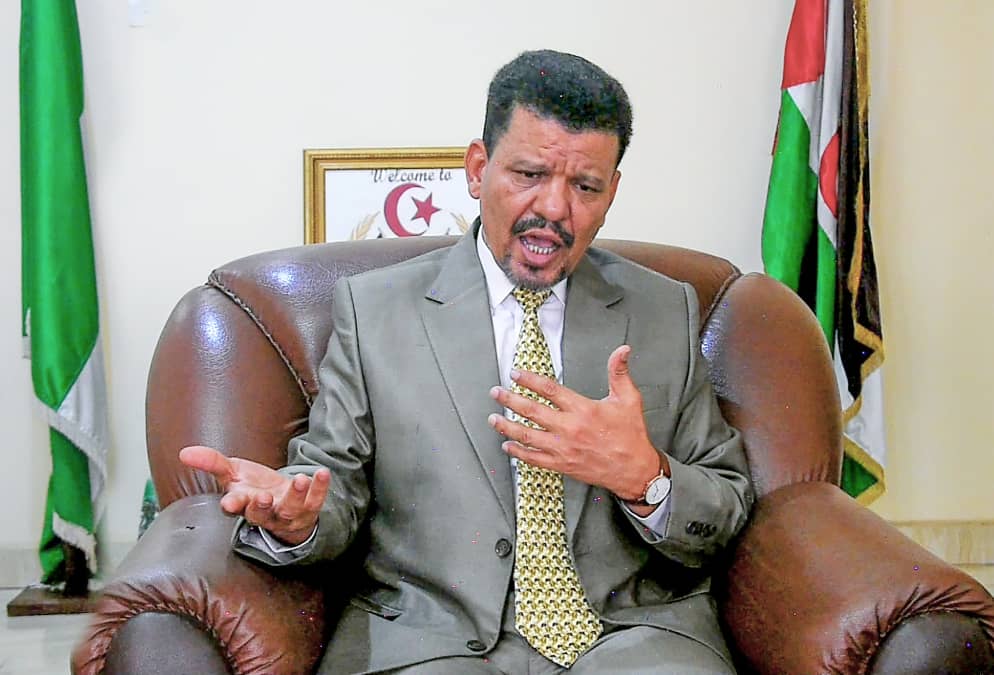
The Minister of Foreign Affairs and African Affairs of the Sahrawi Arab Democratic Republic (SADR) and Special Envoy, Mohamed Yeslem Beysat, speaks in this interview about the Sahrawi Republic’s quest for self-determination, Nigeria’s longstanding role in defending justice, international law and African-led solutions to African challenges. He also calls for global action to protect the rights of Sahrawi prisoners under Moroccan detention, urges Morocco to respect their fundamental rights and ensure their humane treatment, while highlighting the role of the African Union in resolving the Western Sahara dispute, among other issues.
What is the purpose of your visit to Nigeria?
I am in Nigeria as the Special Envoy of His Excellency President Ibrahim Ghali, President of the Sahrawi Republic. I delivered a written message from President Ghali to his brother and colleague, President Bola Ahmed Tinubu.
During my visit, I was received by Nigeria’s Minister of State for Foreign Affairs, where I presented the letter. We also reviewed the state of bilateral relations and discussed ways to strengthen cooperation. Furthermore, I expressed our deep appreciation for Nigeria’s longstanding role in defending justice, international law, and promoting African solutions to African problems.
What is the current level of bilateral trade between Nigeria and the Sahrawi Republic?
Trade relations are still very limited. However, both countries have the political will and determination to deepen cooperation in political, economic, and other areas of mutual interest.
During your previous visit, you advocated for the Sahrawi Republic’s quest for self-determination. How far has that process progressed?
We used this visit to brief our Nigerian brothers on recent developments. Under the United Nations-led peace process, supported by the United States, three rounds of direct negotiations have been held between the Sahrawi Republic and the Kingdom of Morocco.
These talks are based on UN Security Council resolutions calling for direct negotiations without preconditions to achieve a mutually acceptable political solution that guarantees the Sahrawi people’s right to self-determination.
The Sahrawi Republic remains committed to constructive dialogue. However, since Morocco’s military actions in 2020, armed conflict has continued, with frequent military engagements.
We are also deeply concerned about the humanitarian situation, particularly the condition of Sahrawi political prisoners in Moroccan prisons. Human rights defender Naama Asfari has been on a prolonged hunger strike, and we fear for his life.
We appeal to all peace-loving people and the international community to urge Morocco to respect the fundamental rights of Sahrawi prisoners and ensure their humane treatment.
What role has the African Union played in resolving the dispute?
The peace process originated from an Organisation of African Unity (OAU) resolution, which proposed a referendum on self-determination. That initiative later became the basis of the joint UN-OAU settlement plan.
Unfortunately, Morocco has consistently rejected efforts aimed at implementing that agreement.
More recently, the African Union’s Johannesburg Declaration on Silencing the Guns called for an immediate ceasefire between the two member states and direct negotiations to prepare for a referendum.
We believe the African Union should play a leading role because this is fundamentally an African issue involving two African states. Unfortunately, Morocco has rejected AU involvement by refusing visits from AU institutions and insisting that the matter remains exclusively under the United Nations.
What discussions did you have with the Nigerian government, and what was the response?
Nigeria has always been a steadfast supporter of the Sahrawi Republic. It remains one of Africa’s leading powers economically, politically, and militarily, and has historically championed decolonisation across the continent.
The Nigerian government reaffirmed its solidarity with the Sahrawi people and agreed on the importance of African-led solutions through the African Union.
What natural resources does the Sahrawi Republic possess?
Western Sahara is richly endowed with natural resources. It has significant deposits of phosphate, iron ore, copper, gold, and considerable potential in oil and gas.
The country also possesses some of the world’s richest fishing grounds and enormous solar energy potential.
Our vision is to ensure these resources benefit not only the Sahrawi people but also contribute to Africa’s broader economic development rather than being exploited by external interests.
Finally, what is the Sahrawi Republic asking from the international community?
We are not asking for special treatment or extraordinary concessions. We simply seek the faithful implementation of international law.
We want the decisions of international courts, including those of the International Court of Justice, the African Court, and the European Court, as well as the principles of the African Union and the United Nations Charter, to be respected.
We believe a rules-based international order can only exist if international law is applied consistently. Our people deserve their inalienable rights to freedom, self-determination, and dignity.
Any final remarks?
Thank you very much for the opportunity. That is all I wish to say.