Joel Ajayi
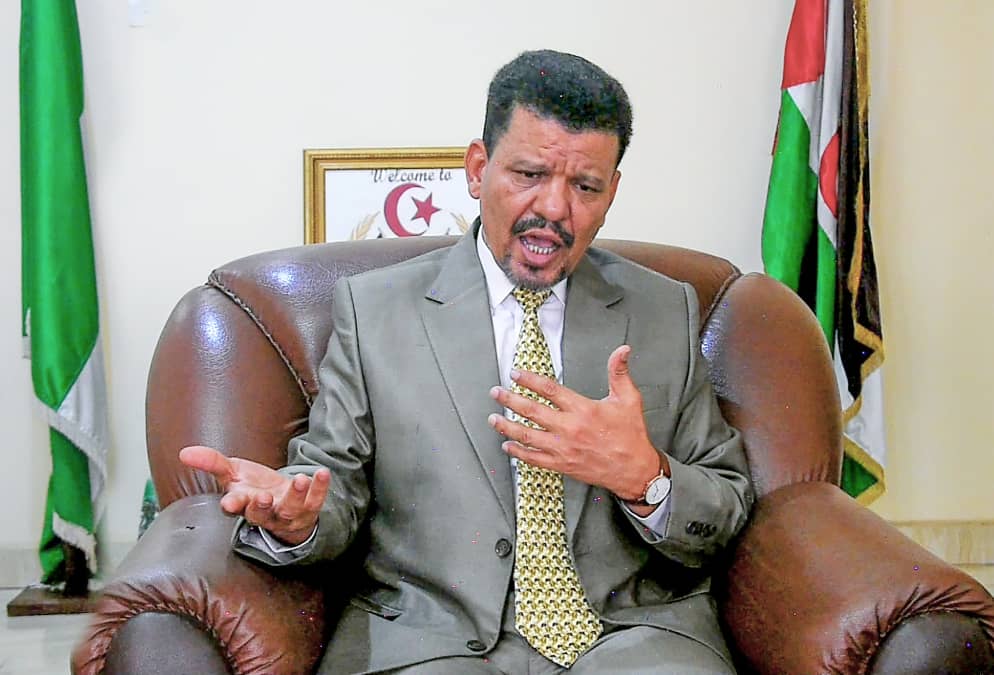
The Special Envoy of the Sahrawi Arab Democratic Republic (SADR) to Nigeria Mohamed Yeslem Beysat has appealed to the Nigerian government and the international community to intensify efforts toward protecting the rights of Sahrawi prisoners held in Moroccan custody, insisting that respect for international law remains the only path to a lasting resolution of the Western Sahara dispute.
The envoy, who was in Abuja on a special mission from President of the Sahrawi Republic, Brahim Ghali, said his visit was aimed at delivering a personal message to President Bola Ahmed Tinubu while strengthening bilateral relations between Nigeria and the Sahrawi Republic.
Speaking during an interview, on Wednesday in Abuja the envoy said he presented President Ghali’s written message to Nigeria’s Minister of State for Foreign Affairs and used the opportunity to commend Nigeria’s longstanding commitment to justice, international law, decolonisation and African-led solutions to continental challenges.
According to him, Nigeria remains one of Africa’s most influential nations and has consistently stood with the Sahrawi people in their quest for self-determination.
“We expressed our deep appreciation for Nigeria’s longstanding role in defending justice, international law and promoting African solutions to African problems,” he said.
The envoy disclosed that although economic and trade relations between both countries remain limited, there is strong political commitment on both sides to expand cooperation in political, economic and other areas of mutual interest.
Addressing the protracted Western Sahara conflict, the envoy said the Sahrawi Republic remains committed to the United Nations-led peace process, noting that three rounds of direct negotiations have been held with Morocco under UN auspices and with the support of the United States.
He explained that the negotiations are based on United Nations Security Council resolutions calling for direct talks without preconditions to achieve a mutually acceptable political solution that guarantees the Sahrawi people’s right to self-determination.
However, he lamented that the security situation has deteriorated since the resumption of hostilities in 2020, saying military confrontations have continued despite ongoing diplomatic efforts.
The envoy expressed particular concern over the plight of Sahrawi political prisoners detained in Morocco, describing their condition as alarming.
He cited the case of Sahrawi human rights defender Naama Asfari, who he said has been on a prolonged hunger strike, raising fears over his health and safety.
“We appeal to Nigeria, peace-loving people and the international community to urge Morocco to respect the fundamental rights of Sahrawi prisoners and ensure their humane treatment,” he said.
On the role of the African Union, the envoy maintained that the continental body should take a leading role in resolving the dispute because it involves two African states.
He recalled that the original peace initiative emerged from a resolution of the former Organisation of African Unity (OAU), which proposed a referendum on self-determination before evolving into the joint UN-OAU settlement plan.
According to him, more recent AU initiatives, including the Johannesburg Declaration on Silencing the Guns, have also called for an immediate ceasefire and renewed negotiations aimed at organising a referendum.
He, however, alleged that Morocco has consistently rejected AU involvement by refusing visits from AU institutions while insisting that the issue should remain solely under the United Nations framework.
The envoy praised Nigeria for reaffirming its solidarity with the Sahrawi people during his meetings with government officials, describing the country as a historical champion of African liberation and decolonisation.
“Nigeria has always been a steadfast supporter of the Sahrawi Republic. The Nigerian government reaffirmed its solidarity with our people and agreed on the importance of African-led solutions through the African Union,” he stated.
Highlighting the economic prospects of the Sahrawi Republic, the envoy said Western Sahara possesses abundant natural resources, including phosphate, iron ore, copper, gold, fisheries, as well as significant oil, gas and solar energy potential.
He stressed that the country’s vision is to ensure these resources benefit not only the Sahrawi people but also contribute to Africa’s broader economic development.
Concluding the interview, the envoy said the Sahrawi Republic was not seeking special treatment from the international community but rather the consistent application of international law.
He called for the implementation of decisions of international judicial bodies, including the International Court of Justice, the African Court and the European Court, alongside adherence to the principles of the African Union and the United Nations Charter.
“Our people deserve their inalienable rights to freedom, self-determination and dignity. A rules-based international order can only exist if international law is applied consistently,” he said.