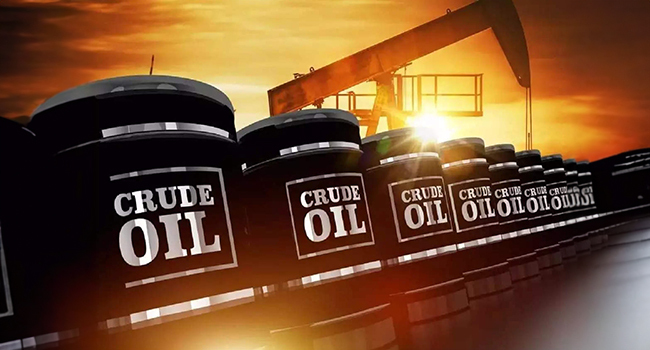
Global oil prices climbed sharply on Thursday after United States President Donald Trump declared that the ceasefire with Iran had ended and ordered fresh military strikes following attacks on ships in the Strait of Hormuz.
The renewed tensions pushed crude prices higher as investors reacted to concerns over potential disruptions to global energy supplies.
Both major oil benchmarks gained about eight per cent, with Brent crude rising above $80 per barrel for the first time in two weeks, raising fresh concerns about inflation and its potential impact on the global economy.
The latest rally followed Trump’s announcement of additional military action against Iran after accusing Tehran of carrying out attacks on vessels in the strategic Strait of Hormuz, a waterway through which roughly one-fifth of the world’s oil supply is transported.
In a post on Truth Social, Trump said the latest strikes were launched in response to the previous day’s attacks.
“This is in retribution for yesterday’s bombing of ships by Iran,” he wrote.
The United States also revoked a temporary sanctions waiver that had allowed limited Iranian oil transactions, further increasing pressure on global energy markets.
Despite ordering new strikes, Trump suggested earlier that he still expected the latest escalation to be short-lived and indicated that diplomatic engagement remained possible.
He claimed Iranian officials had recently reached out seeking renewed negotiations, although he did not disclose further details or identify those involved in the reported communication.
Trump also questioned the prospects of a new agreement, describing Iranian leaders as “sort of crazy.”
Commenting on market reaction, Neil Wilson of Saxo Markets said Trump’s remarks heightened fears of a renewed escalation between the two countries.
He noted that investors were increasingly concerned about the possibility of negotiations collapsing and a return to heightened regional instability.
However, Wilson said he did not believe a complete breakdown in diplomacy remained the most likely outcome, arguing that both Washington and Tehran still had incentives to restore a measure of stability.
While oil prices surged, most equity markets traded higher as investors took advantage of recent declines in technology stocks.
Major gains were recorded in Tokyo and Seoul, while Hong Kong extended its recent rally, supported by strength in Chinese technology companies.
Stock markets in Shanghai, Singapore, Wellington and Taipei also closed higher.
Investor attention also turned to South Korean semiconductor manufacturer SK hynix ahead of its planned United States stock market debut.
The company’s American Depository Receipts reportedly attracted demand more than seven times the number of shares available before pricing, with analysts estimating the offering could raise up to $28 billion.
Shares of SK hynix listed in Seoul rose nearly seven per cent on Thursday, although the company has lost more than 30 per cent of its market value since reaching a record high last month amid the broader sell-off in technology stocks.
Key Figures Around 0230 GMT
West Texas Intermediate: UP 1.4 per cent at $74.52 a barrel
Brent North Sea Crude: UP 1.3 per cent at $79.00 a barrel
Seoul – Kospi: UP 2.2 per cent at 7,404.73
Tokyo – Nikkei 225: UP 2.0 per cent at 68,180.55 (break)
Hong Kong – Hang Seng Index: UP 0.5 per cent at 24,319.47
Shanghai – Composite: UP 0.1 per cent at 3,974.63
Dollar/yen: DOWN at 162.47 yen from 162.54 yen on Wednesday
Euro/dollar: UP at $1.1427 from $1.1422
Pound/dollar: UP at $1.3399 from $1.3396
Euro/pound: UP at 85.28 pence from 85.26 pence
New York – Dow: DOWN 1.1 per cent at 52,348.39 (close)
London – FTSE 100: DOWN 1.7 per cent at 10,489.04 (close)