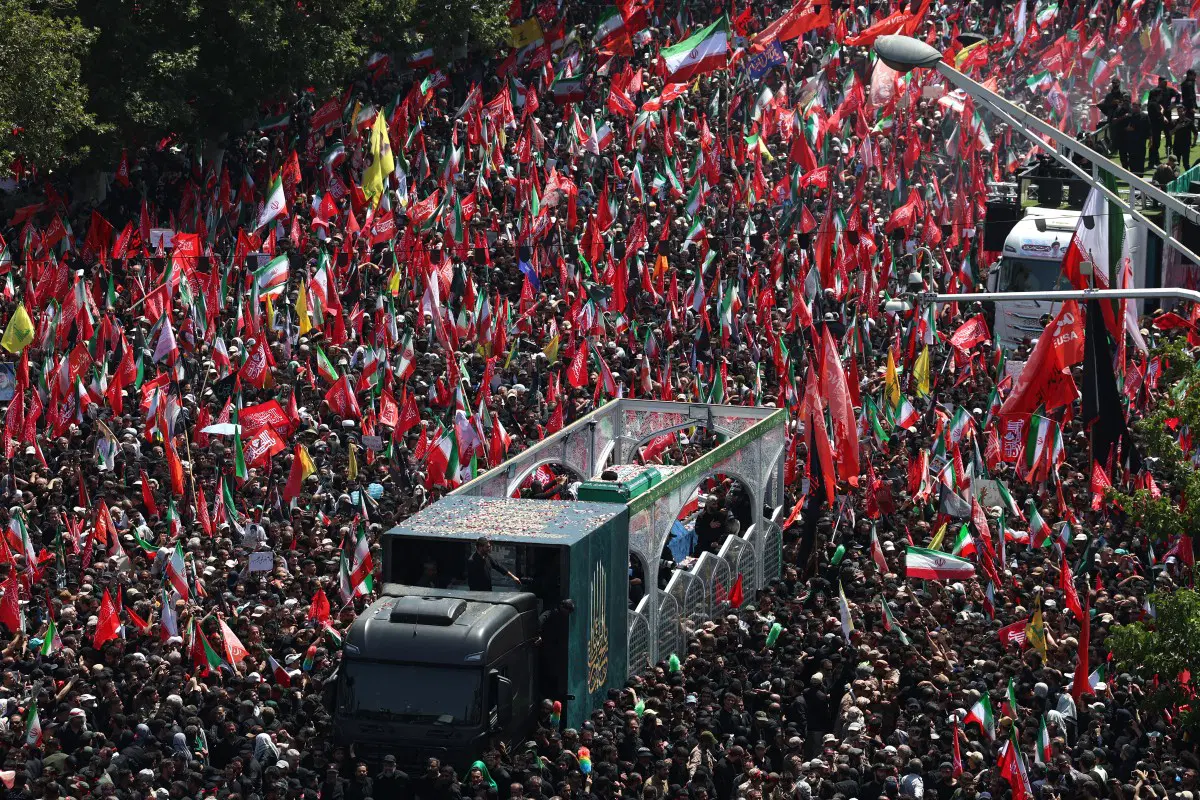
The funeral procession for Iran’s late Supreme Leader, Ali Khamenei, commenced in Tehran on Monday as thousands of mourners flooded the streets to bid farewell to the leader who governed the Islamic Republic for more than 35 years.
State television reported that the procession began after Khamenei’s body had lain in state for two days at Tehran’s Grand Mosalla religious complex, with authorities expecting turnout figures that could rival the funeral of Ayatollah Ruhollah Khomeini in 1989.
The ceremonies are also being viewed as an opportunity for Iran to demonstrate national unity and resilience following five weeks of conflict with the United States and Israel.
Attention has equally remained fixed on Khamenei’s successor, his son Mojtaba Khamenei, who has yet to make a public appearance since assuming leadership.
According to state broadcaster IRIB, Khamenei’s body, along with those of four family members who were killed in the February 28 airstrikes, began its journey through the Iranian capital surrounded by large crowds.
State media reported that mourners gathered at Imam Hussein Square in eastern Tehran, where an effigy of United States President Donald Trump was hung during the procession.
Authorities have taken extensive precautions to prevent a repeat of the tragic scenes witnessed during Ayatollah Khomeini’s funeral in 1989, when an estimated 10 million people attended.
The overwhelming crowd at that event led to stampedes that reportedly killed more than 10 people and injured over 10,000 others.
Thousands of mourners had filled the Grand Mosalla on Sunday to pay their final respects to Khamenei and his relatives before the public procession began.
Massive concrete barriers were erected around the coffins to prevent crowd surges and ensure public safety.
Officials have not disclosed how close members of the public will be allowed to approach the funeral cortege during the procession, mindful of the chaos that disrupted Khomeini’s burial nearly four decades ago.
During that funeral, authorities were forced to transport Khomeini’s body by helicopter after mourners overwhelmed the vehicle carrying his remains, causing his burial shroud to tear.
Beyond honouring the late leader, Iranian officials are also using the funeral ceremonies to project strength following weeks of military confrontation with Israel and the United States.
Parliament Speaker and Iran’s chief negotiator with Washington, Mohammad Bagher Ghalibaf, praised the large turnout, describing it as evidence of the unity of the Iranian people.
“The proud and invincible nation of Islamic Iran unanimously” honoured its “martyr,” he wrote on X.
The funeral programme will continue with additional ceremonies in the religious city of Qom on Tuesday before proceeding to the Iraqi holy cities of Najaf and Karbala on Wednesday.
Khamenei will eventually be laid to rest in his hometown of Mashhad in northeastern Iran on Thursday.
Three of Khamenei’s sons appeared publicly during Sunday’s ceremonies, drawing attention to the continued absence of Mojtaba Khamenei, who was appointed Supreme Leader shortly after his father’s death.
Iranian officials have stated that Mojtaba sustained injuries during the February 28 airstrikes, although details regarding the extent of those injuries remain unclear.
The newly appointed commander of the Revolutionary Guards, Ahmad Vahidi, whose predecessor was also killed in the February strikes, attended the ceremonies publicly for the second consecutive day.
The head of the Revolutionary Guards’ Quds Force, Esmail Qaani, also made a rare appearance during the funeral events.
While the government has sought to project unity, none of Iran’s surviving former presidents, many of whom had strained relationships with Ali Khamenei, have been seen at the ceremonies.
Calls for retaliation against those blamed for Khamenei’s death have also dominated the funeral events.
“The killers of Khamenei must face punishment,” one mourner identified as Miremadi told AFP during Sunday’s prayers.
Another mourner, identified only by the surname Bakand, said the Iranian people remained committed to the country’s leadership.
“We back our revolution and our leader, and we demand revenge for the blood of our loved ones,” she said.
Khamenei maintained a confrontational foreign policy throughout his tenure and oversaw Iran’s support for several anti-US and anti-Israel groups across the Middle East, including Hamas and Hezbollah, both of which sent delegations to participate in the funeral ceremonies.