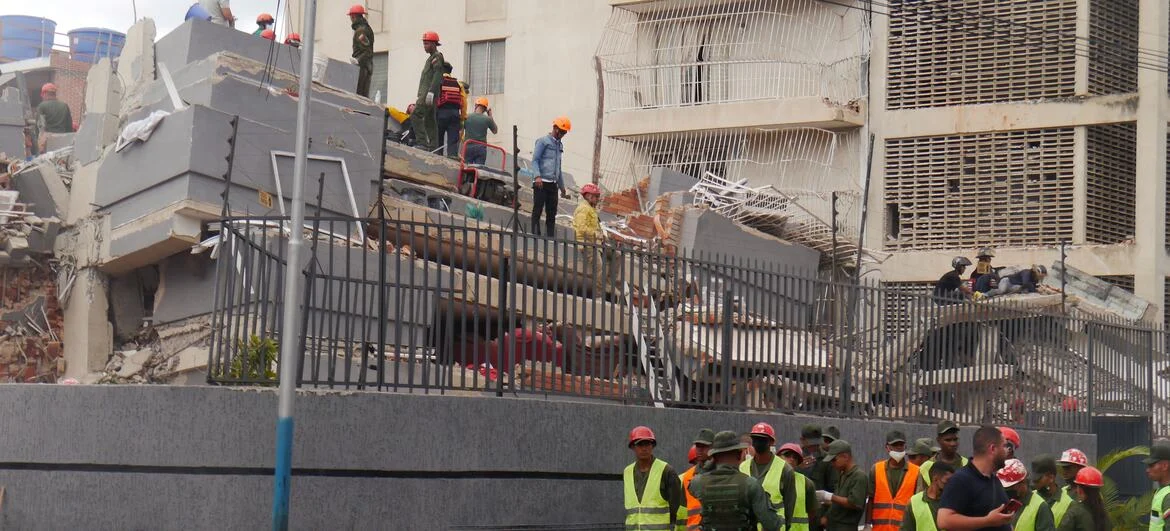
Rescue workers in Venezuela have pulled a three-year-old child alive from beneath collapsed debris in La Guaira, six days after two powerful earthquakes devastated parts of the country.
The dramatic rescue in the northern coastal region, one of the areas worst affected by the disaster, has offered a rare moment of hope as thousands of survivors continue to struggle with the aftermath of the twin earthquakes.
The 7.2- and 7.5-magnitude earthquakes struck less than a minute apart on June 24, leaving widespread destruction across several states.
Despite the successful rescue, tens of thousands of residents remain without adequate shelter as humanitarian agencies continue emergency response operations.
The United Nations High Commissioner for Refugees warned that humanitarian needs are increasing rapidly as the scale of the disaster becomes clearer.
“As the death toll rises, needs are skyrocketing,” the agency said in an online update.
Official figures released by Venezuelan authorities indicate that nearly 2,000 people have lost their lives, while more than 6,400 individuals have been rescued since the earthquakes struck.
Several United Nations agencies, alongside humanitarian partners, continue to work with local authorities in the hardest-hit communities to provide shelter, healthcare, protection services and other emergency assistance.
The United Nations Office for the Coordination of Humanitarian Affairs (OCHA) stressed the importance of sustaining rescue operations.
“Every life matters,” the agency said on Wednesday, as both local and international search-and-rescue teams remained active in La Guaira.
United Nations Disaster Assessment and Coordination (UNDAC) teams are also continuing field assessments to determine where humanitarian assistance is most urgently required.
UNDAC Public Information Officer Veronique Durroux said the teams are working to identify affected communities and prioritise emergency interventions.
The earthquakes caused extensive structural damage across the country.
Authorities estimate that approximately 1,000 buildings—including hospitals—were either damaged or completely destroyed.
More than 400 schools and several water supply systems also sustained significant damage.
In response to the emergency, the United Nations Children’s Fund (UNICEF) delivered an initial shipment of 47 tonnes of humanitarian supplies to Venezuela on Tuesday.
The delivery followed an earlier shipment that arrived from Panama on June 28.
Combined, the relief supplies are expected to support more than 100,000 children and families over the next three months.
“UNICEF is on the ground and working around the clock to reach as many children and families as possible. The first flights with water, medicine and many other supplies have reached the country, and we are grateful for the solidarity. And we ask for donations to UNICEF because with more funds, we can save more lives, reach more children, and reach as many families as possible,” UNICEF official Gabriel Vockel said while speaking in La Guaira.
The humanitarian cargo, facilitated through the European Union and UNICEF’s logistics hub in Copenhagen, includes emergency medical kits, maternal healthcare supplies, newborn care materials, medicines for disease prevention and treatment, as well as water purification equipment.
The shipment also contains water storage supplies, tents designated as child-friendly spaces, wheelchairs and educational and recreational materials aimed at helping children regain a sense of normalcy following the disaster.
UNICEF Regional Director for Latin America and the Caribbean, Roberto Benes, said many affected families continue to face severe hardships.
“Families across the affected states are in urgent need of safe water, as well as access to health care.
“Many are sleeping outside, afraid of more aftershocks. These supplies will help us reach children and families with what they need most right now… But the needs on the ground are far greater than what’s arrived,” Benes said.
According to UNICEF, approximately 680,000 children require humanitarian assistance across the six states impacted by the earthquakes, described as Venezuela’s most powerful seismic event in more than a century.
The agency also warned that communities remain vulnerable due to continued seismic activity, with more than 600 aftershocks recorded since the initial earthquakes.
UNICEF estimates that $52 million is required to finance its earthquake response efforts as part of its broader 2026 Humanitarian Action for Children appeal for Venezuela, which seeks a total of $137.6 million.
Before the earthquakes struck, only 35 per cent of that appeal had been funded.