Joel Ajayi
The Africa Polling Institute (API) has revealed that the National Assembly is now Nigeria’s least trusted public institution, overtaking the Police in public distrust, according to findings from its 2026 Nigeria Social Cohesion Survey unveiled in Abuja on Thursday.
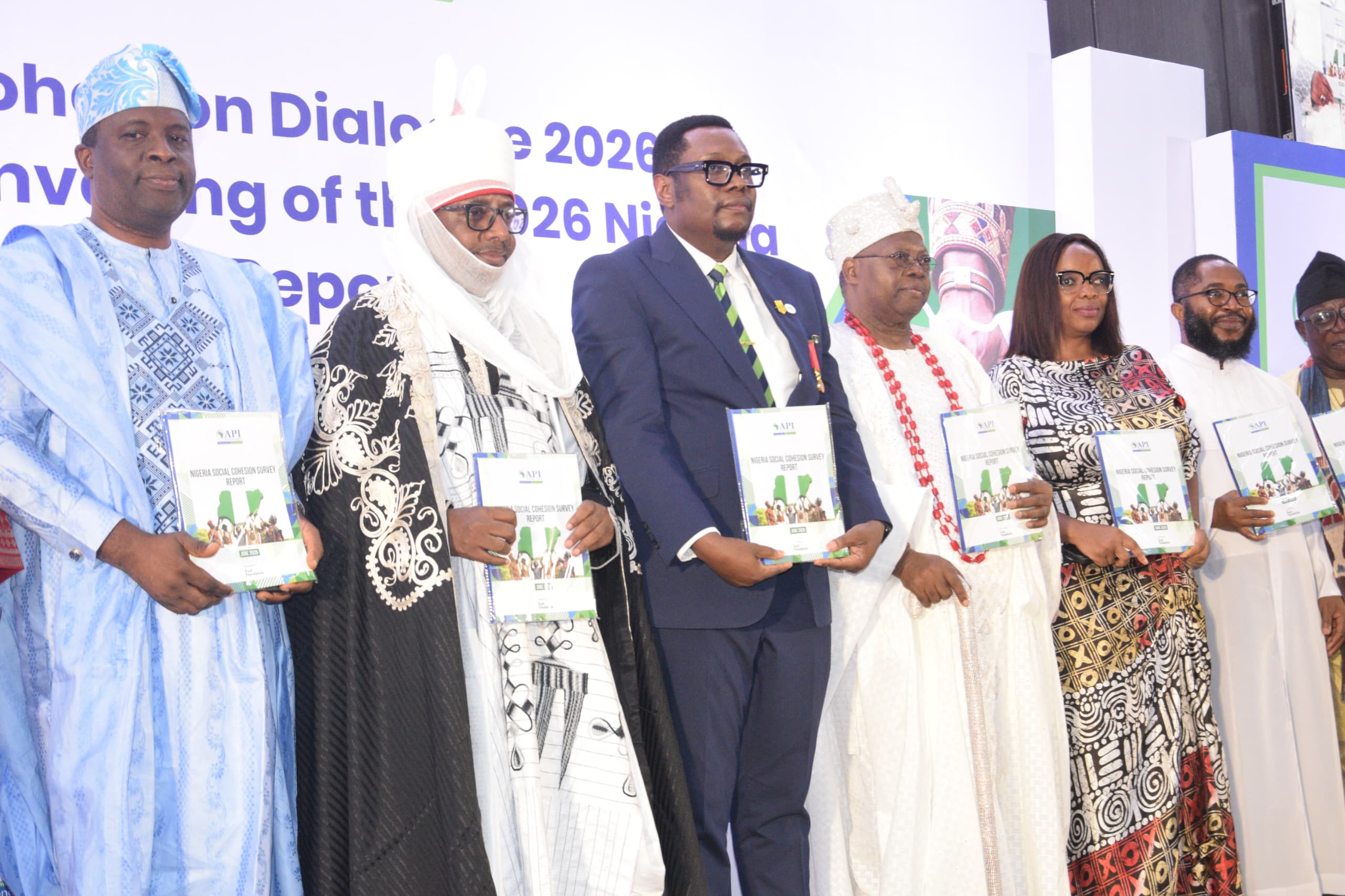
Speaking at the 2026 National Social Cohesion Dialogue and the public presentation of the survey report, API Executive Director, Professor Bell Ihua, said the latest findings point to both growing national unity and persistent concerns over citizens’ trust in government institutions.
According to Ihua, Nigeria’s Social Cohesion Index (NSCI) currently stands at 48.8 percent, representing a two-percentage-point increase from the previous year and the highest level recorded since the survey commenced.
He explained that although the index remains slightly below the 50 percent benchmark, the upward movement reflects Nigerians’ resilience and increasing willingness to embrace unity despite tribal, religious, political, and social differences.
“One of the most significant findings from this year’s survey is that, for the first time since the study began, a majority of respondents identified primarily as Nigerians rather than by ethnic, religious, or regional affiliations,” Ihua stated.
He described the development as a major milestone in Nigeria’s nation-building journey, noting that it signals a strengthening sense of shared national identity and renewed hope for national cohesion.
Despite this positive trend, the survey revealed a deep trust deficit in public institutions. Only 23 percent of Nigerians expressed trust in the National Assembly, placing it below the Police, which recorded 24 percent trust. Similarly, only 28 percent of citizens said they trust the administration of Bola Ahmed Tinubu.
In contrast, religious and traditional institutions remain the most trusted among Nigerians. The survey showed that 51 percent of respondents expressed significant trust in religious leaders, while 45 percent trusted traditional rulers.
Ihua said this trust gap informed the theme of this year’s dialogue, which focused on strengthening the role of religious and traditional institutions as critical agents of social cohesion, peacebuilding, and national stability.
The report also highlighted strong civic commitment among Nigerians. About 71 percent of citizens said they are willing to sacrifice personal interests for the common good, while 77 percent expressed readiness to cooperate with people from other ethnic groups to strengthen national unity. Another 73 percent said they are willing to participate actively in the political process.
However, the survey reflected mixed feelings regarding national unity. While 48 percent of respondents believe Nigeria is more divided today than it was four years ago, 20 percent said the country is more united. Political party affiliation emerged as the leading cause of division, ahead of ethnic and religious differences.
On gender equity, 69 percent supported women occupying leadership positions in politics and corporate organisations, while 60 percent said they would vote for a female president.
The survey further found that 55 percent of Nigerians would relocate abroad with their families if given the opportunity. Nonetheless, optimism remains strong, with 61 percent believing Nigeria’s future will be better than its present condition.
The study, supported by the Ford Foundation, involved 5,315 face-to-face interviews conducted nationwide between January and February.
To address the trust deficit, API recommended the establishment of a National Social Cohesion Commission, modeled after Kenya’s framework, to promote inclusive governance, national identity, trust, peaceful coexistence, and unity. It also urged Ministries, Departments, and Agencies to establish dedicated social cohesion desks to ensure public policies foster inclusion and national integration.