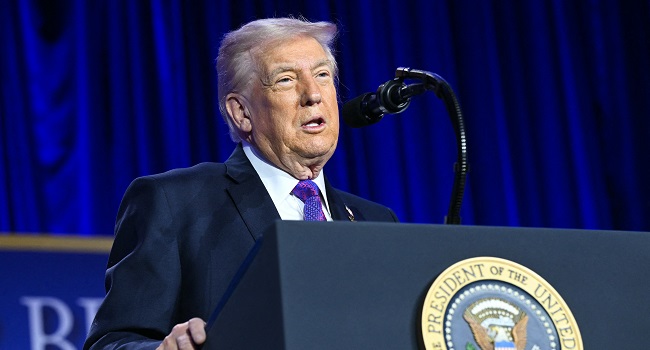
United States President, Donald Trump, has warned that military action against Iran could resume if Tehran fails to comply with the terms of an expected agreement aimed at ending hostilities between the two countries.
Speaking on Wednesday during the G7 summit alongside Abdel Fattah el-Sisi, Trump described the anticipated agreement, scheduled to be signed in Switzerland on Friday, as a memorandum of understanding rather than a final settlement.
“No, it’s not final. It’s a memorandum of understanding,” Trump said when asked about the accord.
He cautioned that the United States would not hesitate to take military action again if Iran failed to honour its commitments.
“If I don’t like it, we will go back to shooting at them,” Trump stated.
The American president further warned that Iran could face renewed airstrikes if its leadership failed to comply with the agreement.
“If they don’t behave, we’ll go right back to dropping bombs right smack in the middle of their head,” he said.
Trump also criticised the Iranian government, accusing it of decades of hostile behaviour since the 1979 Islamic Revolution that led to the establishment of the Islamic Republic.
“Because they misbehaved for 47 years,” he added.
The conflict between the United States, Israel and Iran reportedly began on February 28 following airstrikes that killed senior Iranian officials, including Supreme Leader Ali Khamenei and other top figures.
The accord expected to be signed in Switzerland is intended to formally end the conflict and create a framework for further negotiations.
According to details released ahead of the signing, comprehensive talks on a permanent settlement between Washington and Tehran will begin immediately after the agreement is endorsed.
The negotiations are expected to continue over a 60-day period, during which both sides will work to establish the terms of a long-term resolution to the crisis.
The upcoming talks are seen as a critical step toward preventing a return to open hostilities and addressing broader issues surrounding regional security and relations between the two countries.