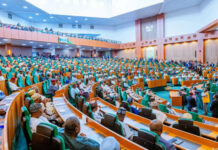
.Signing reflects President’s resolve to continuously improve electoral framework -Ex-legislators
.CNPP demands ‘sensitivity to legitimate democratic concerns’
.Says Nigeria stands at a defining moment in consolidating democratic governance
By Caleb Ishaya, Abuja
President Bola Tinubu’s signing of the Electoral Act Amendment Bill 2026 into law has triggered reactions for and against the president’s ascent to the recently passed Act by the two chambers of the National Assembly.
The brief signing ceremony took place at the President’s office at the State House, Abuja with Principal officers of the National Assembly in attendance.
The National Assembly had on Tuesday passed the Electoral Act 2026 (Amendment) Bill.
The amendment comes amid intense public debate over the electronic transmission of election results in real time.
The harmonised report of the bill, including the contentious Section 60(3), was passed by both chambers on Tuesday.
While signing the bill at the State House on Wednesday in the presence of top government officials, including the President of the Hosea, Godswill Akpabio; the Speaker of the House of Representatives, Tajudeen Abbas; and the Chief of Staff to the President, Femi Gbajabiamila, Tinubu said the essence of democracy was to have very solid discussions committed to national development and nation-building, essential for the stability of the nation.
According to him, it was high time Nigerians had confidence in their system.
“It’s not as important as the historical aspects of this. What is crucial is the fact that you manage the process to the extent that there will be no confusion, no disenfranchisement of Nigerians, and that we are all going to see democracy flourish.
“No matter how good the system is, it’s managed by the people, promoted by the people, and the result is finalised by the people”, the President said.
Meanwhile, the National Forum of Former Legislators, NFFL, has described the 2026 Electoral Act amendment as a boost to Nigeria’s democracy ahead of the 2027 general elections.
In a statement yesterday, National Coordinator, Mr Raphael Igbokwe, lauded President Bola Tinubu for signing the amended law.
Igbokwe also commended the National Assembly for what he called a timely and responsive legislative effort that ensured swift passage of the amendment.
“The National Forum of Former Legislators warmly commends President Tinubu for demonstrating leadership and commitment to democratic reforms by assenting to the Electoral Act 2026 (Amendment).
“This action reflects the President’s resolve to continuously improve Nigeria’s electoral framework.
“We equally commend the National Assembly for listening to the voice of the masses and civil society groups.
“The adjustments strike a practical balance between technological innovation and infrastructure challenges in parts of the country”, Igbokwe stated.
He said signing the law well ahead of the 2027 polls gives INEC, political parties and other stakeholders ample time to prepare within a clear legal framework.
Igbokwe noted that the amendment followed shortly after INEC released the 2027 election timetable, providing clarity and stability for political actors and voters.
He urged INEC to ensure transparent and consistent implementation, stressing that public confidence would depend largely on how the amended law is applied.
The coordinator also called on political parties and security agencies to fulfil their roles in guaranteeing peaceful and credible elections.
He said the success of the 2027 general elections would depend not only on legislation, but on stakeholders’ collective commitment to democratic values.
However, the Conference of Nigeria Political Parties, CNPP, has expressed “profound disappointment and deep national concern following the decision of the President of the Federal Republic of Nigeria, Bola Ahmed Tinubu, to sign the 2026 Electoral Act Amendment into law”.
In a statement signed by its Deputy National Publicity Secretary, Comrade James Ezema, the CNPP lamented that “this presidential assent represents, in our considered view, a missed historic opportunity to correct structural loopholes that we and other critical stakeholders had earlier identified in the amendment adopted by the House of Representatives of Nigeria and the Senate of Nigeria”.
The CNPP noted that it “had previously raised serious concerns over controversial provisions in the amendment, particularly the clause permitting a Presiding Officer at a polling unit to rely on Form EC8A as the primary source for result collation where electronic transmission of results is allegedly impossible due to network failure. Our objection was never to the acknowledgment of technological limitations in remote areas; rather, it was to the dangerous absence of a transparent, objective, and independently verifiable framework for determining when a network failure has genuinely occurred”.
“By leaving the determination of network failure substantially at the discretion of individual polling unit officials, the newly signed law creates an exploitable loophole capable of undermining the integrity of the electoral process. Modern electoral governance must be anchored on measurable, auditable, and tamper-proof procedures. Unfortunately, the amendment weakens the technological safeguards painstakingly introduced in recent electoral reforms.
“Nigeria has made incremental progress through electronic transmission of results and digital accreditation systems. These innovations were designed to reduce human interference and result manipulation during collation. The reintroduction of incident form-style procedures without strict regulatory and verification safeguards risks reversing those gains and reopening vulnerabilities that electoral reforms sought to close.
“Beyond procedural weaknesses, we are deeply concerned about the potential security implications of this law. In many communities across the country, network availability is easily verifiable by citizens using personal mobile devices. Situations where voters demonstrably have access to network services while a Presiding Officer declares network failure to justify manual collation could generate distrust, confrontation, and possible breakdown of law and order.
“Such contradictions may expose officials of the Independent National Electoral Commission, INEC, to avoidable suspicion and hostility, thereby jeopardising both the credibility of the electoral process and the personal safety of electoral personnel.
“With the nation approaching the 2027 general elections, legal ambiguities capable of generating widespread disputes should have been eliminated, not institutionalised. The current legal framework, as amended, risks fueling post-election litigations, public protests, and erosion of voter confidence — developments that could threaten national democratic stability.
“While we acknowledge the constitutional authority of the President to assent to legislation, leadership equally demands foresight and sensitivity to legitimate democratic concerns. The CNPP therefore calls on INEC and all relevant institutions to urgently develop stringent, technology-driven implementation guidelines that will mitigate the risks inherent in this amendment.
“We strongly urge the establishment of objective, real-time network verification protocols integrated with national telecommunications infrastructure, mandatory multi-layer authentication and timestamp safeguards before any manual collation can be activated, enforceable accountability measures against false declarations of network failure, and transparent reporting systems accessible to political parties and accredited observers.
“The CNPP reiterates its unwavering commitment to credible, transparent, and technologically driven elections in Nigeria. The survival of public trust in the 2027 general elections will depend not merely on the existence of laws, but on the integrity, transparency, and courage with which they are implemented.
“Nigeria stands at a defining moment in consolidating democratic governance. History will judge all actors in this unfolding electoral framework by whether their decisions ultimately strengthened or weakened the foundations of our democracy”, the CNPP concluded.