- …Says measures are underway to ensure nationwide food security and sufficiency
By Paul Effiong, Abuja
The Federal Ministry of Agriculture and Food Security has outlined the ongoing efforts of the President Bola Ahmed Tinubu administration to boost domestic food production and reverse the growing threat of food insecurity across Nigeria.
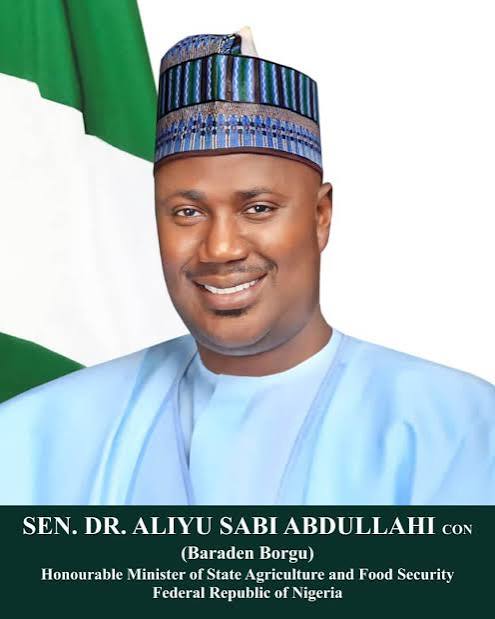
Speaking during the ministry’s 2026 budget defence before the joint Senate and House of Representatives Committees on Agriculture at the National Assembly Complex yesterday, the Minister of State for Agriculture and Food Security, Senator Aliyu Sabi Abdullahi, identified inadequate funding, high input costs and structural bottlenecks as some of the major challenges confronting farmers nationwide.
He noted that these avoidable constraints continue to slow programme implementation and limit the ministry’s capacity to scale up key interventions across critical agricultural value chains.
Responding to lawmakers’ concerns over the adequacy of measures to address food insecurity, the minister said several strategies were already in place, anchored on the Food Security Emergency Programme recently launched by President Tinubu.
Abdullahi further disclosed that while personnel costs under the 2025 budget were largely implemented, capital projects had suffered severe setbacks due to delayed budget releases.
He revealed that about 30 per cent of the ministry’s capital allocation — approximately ₦18 billion — remained unreleased, with only constituency-related projects receiving partial disbursements amounting to about ₦19.8 billion.
Looking ahead to the 2026 fiscal year, the minister said the agricultural sector was projected to receive about ₦1 trillion, with the Federal Ministry of Agriculture and Food Security allocated roughly ₦262 billion for capital expenditure and ₦19.18 billion for recurrent costs.
He explained that rising input prices, driven by macroeconomic pressures such as gas pricing, fertiliser production costs and taxation on agro-chemicals, remained among the most pressing concerns for farmers across the country.
According to him, farmers are increasingly caught between escalating production costs and consumer demand for affordable food, raising serious sustainability concerns.
The minister urged lawmakers to support policies that would improve access to inputs, strengthen domestic fertiliser production, promote mechanisation and accelerate technology adoption, noting that thousands of tractors nationwide remain underutilised due to distribution failures by previous administrations.
Despite the constraints, he expressed optimism that agriculture continued to make a strong contribution to the economy, accounting for 29.44 per cent of GDP in 2024 and 26.17 per cent in the second quarter of 2025.
However, he acknowledged that Nigeria’s budgetary allocation to agriculture — about four per cent of the national budget — remained far below the 10 per cent benchmark set under the Maputo Declaration, thereby limiting the sector’s growth potential.
Earlier in their remarks, the chairmen of the House and Senate Committees on Agriculture warned against declining allocations to the ministry, noting that funding had dropped from ₦2.22 trillion in 2025 to ₦1.45 trillion in the 2026 proposal, a trend they said could deepen food insecurity and weaken economic recovery.
Lawmakers therefore called for increased funding, timely releases and stronger oversight, assuring the ministry of their cooperation in delivering a credible 2026 budget capable of improving farmers’ livelihoods and ensuring affordable food for all Nigerians.