By Ismaila Jimoh, Abuja
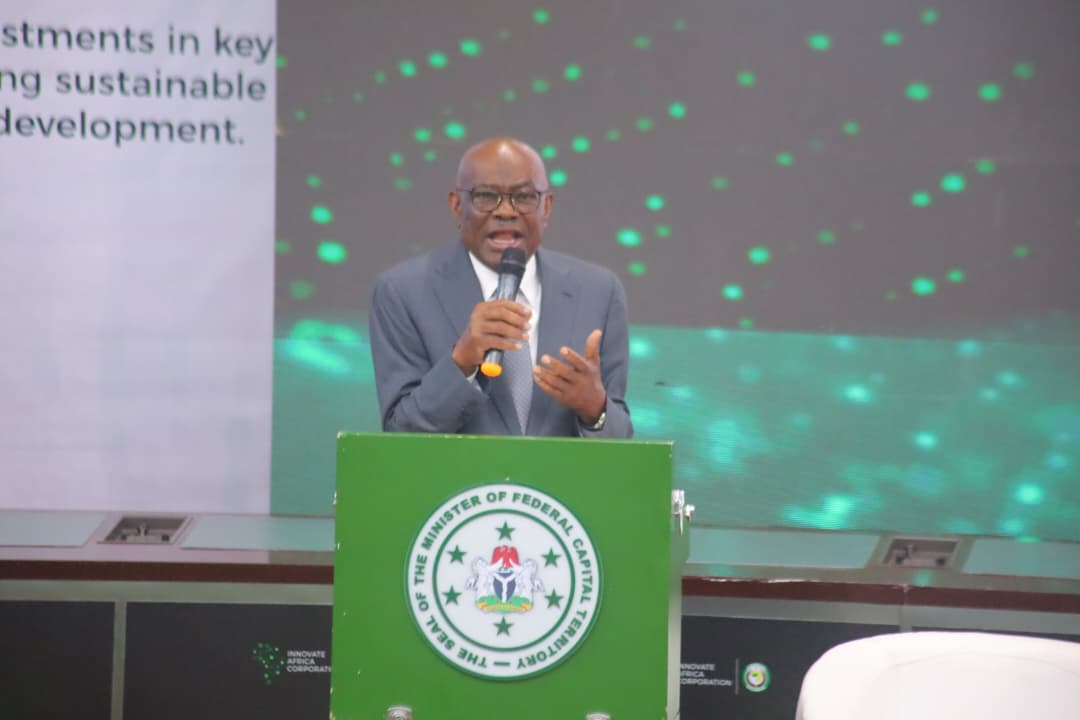
The Minister of the Federal Capital Territory (FCT), Barr. Nyesom Wike has stressed the need for African leaders to do away with pervasive culture of transactional and mediocre leadership which he linked with the continent’s persistent underdevelopment despite its vast resources.
Wike stated this while delivering the keynote address titled “Reimagining Africa’s Leadership and Investment” at the 2025 Innovate Africa Conference, held at the ECOWAS Conference Hall, Abuja.
He lamented that Africa’s leadership trajectory—both in military and civilian dispensations—has for decades been shaped by “self-serving conspiracies that bear little or no relation to national interest or development priorities.”
According to him, “Africa today stands at a historic crossroads. On one hand, we are blessed with immense natural wealth, youthful energy, and creative potential; yet, we continue to grapple with weak institutions, infrastructural decay, poverty, and widespread unemployment. This is the paradox of our age — how can a continent so richly endowed remain so constrained?” he queried.
The minister, who was honoured with the Innovate Africa Leadership Award 2025 at the event, stressed that the decisive factor at the heart of the continent’s paradox lies in leadership — the kind that defines whether abundance becomes prosperity or stagnation.
“Leadership remains the fulcrum upon which the destinies of nations turn. When leadership is visionary, accountable, and courageous, even the most daunting obstacles can be transformed into opportunities,” he said.
He called for a deliberate shift from “transactional leadership”—which he described as one driven by personal gain, patronage, and short-term calculations—to transformational leadership anchored on vision, service, accountability, and courage.
“The time has come to move beyond transactional leadership to embrace transformational governance that empowers rather than exploits, serves rather than rules, and builds rather than blames,” he declared.
“We keep experimenting with the fundamentals of development — basic infrastructure, primary healthcare, credible institutions, and functional economies. The result has been decades of missed opportunities,” he added.
‘Africa Needs Servant-Leaders’
Wike urged African leaders to rediscover the ethos of servant-leadership, noting that true leadership is defined by empathy, humility, and a shared sense of responsibility.
“Africa needs servant-leaders — not bosses who command, but mentors who inspire. Leadership is not about power or position; it is about trust, service, and shared purpose,” he said.
Drawing parallels between effective leadership and infrastructural renewal, Wike cited ongoing transformations in Abuja as proof that vision backed by political will can translate aspirations into tangible outcomes.
“In Abuja, we have seen how infrastructural renewal, anchored on commitment and accountability, can redefine a city’s identity and inspire public confidence. Roads once impassable now connect communities, and abandoned spaces now thrive with enterprise,” he noted.
Wike also commended President Bola Ahmed Tinubu’s “courageous and reform-driven leadership,” especially the removal of fuel subsidy, which he said previous administrations lacked the political will to implement.
He maintained that the president’s efforts to decentralize governance, devolve development through regional commissions, and strengthen security institutions are laying the foundation for national transformation.
“Tinubu demonstrated uncommon courage by confronting Nigeria’s toughest challenge — subsidy removal — a decision that is already yielding dividends in increased revenue for development and economic stability,” Wike said.
On Africa’s Economic Independence
The FCT Minister emphasized that Africa must break free from the cycle of dependency on foreign aid, insisting that “development cannot be donated; it must be built.”
“For too long, Africa has looked outward for solutions that can only come from within. Aid has become a crutch that weakens our resolve. The time has come for Africa to rise beyond the rhetoric of dependency and take ownership of its destiny,” he asserted.
Wike stressed that the continent’s transformation depends on investments that are “productive, inclusive, and homegrown,” adding that Africa’s greatest asset is not its natural resources but its people.
“Seventy percent of Africa’s population is under 30. This is not a statistic; it is a revolution waiting to happen. If we invest in education, innovation, and entrepreneurship, we will unleash the greatest demographic dividend in human history,” he said.
He urged African governments to prioritize infrastructure as the bedrock of sustainable development, arguing that “roads, power, and digital connectivity are the arteries through which development flows.”
Reimagining Africa’s Future Through AfCFTA
Wike identified the African Continental Free Trade Area (AfCFTA) as a key instrument for the continent’s economic rebirth, describing it as “Africa’s second liberation — the liberation of its economy.”
“The AfCFTA is not just a trade agreement; it is a declaration that Africa will no longer be a supplier of raw materials and a dumping ground for finished goods. It is the cornerstone of our collective prosperity,” he said.