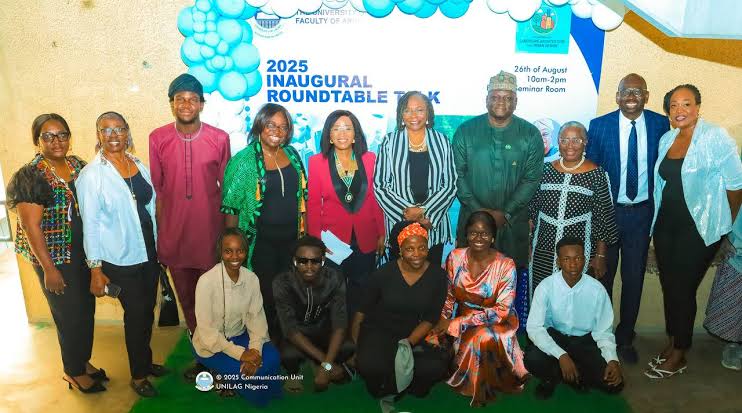
University of Lagos, UNILAG, has inaugurated its Faculty of Architecture, designed to merge interior architecture and ecological design into a progressive and forward-looking curriculum.
The inauguration followed UNILAG’s Architecture Roundtable Talk, a flagship event held Thursday, marking a significant step forward in design education at the institution.
With the theme ‘Designing Resilient Cities: Integrating Landscape and Urban Form for a Sustainable Future’, the talk convened educators, policymakers and design professionals from diverse fields.
Vice Chancellor of the university, Professor Folasade Ogunsola, urged participants to ensure design in African narratives, while embracing cultural resonance, shared heritage and ecological integrity.
She challenged the faculty to foster architecture that reflects identity, place and continuity, stressing that design must be a tool for empowerment, transformation and relevance.
Acting Head of the Department of Landscape Architecture and Urban Design, Dr Nnezi Olugu described the inauguration as a historic and groundbreaking development.
She explained that UNILAG’s bold restructuring filled a long-standing gap in Nigeria’s design education, particularly in urban design and landscape architecture.
“With the integration of urban design, interior architecture and landscape architecture under one faculty, we are witnessing a turning point in architectural education and practice,” she said.
President of the Nigerian Institute of Architects, NIA, Mrs Mobolaji Adeniyi, in a keynote address, redefined resilience as an imperative rather than a luxury.
She highlighted alarming demographic trends, noting that Nigeria’s urban population rose from 15 percent in 1960 to 54 percent in 2022, projected to reach 70 percent by 2050.
“Globally, more than 55 percent of people now live in cities, a figure expected to climb to 68 percent by mid-century,” she added.
Adeniyi stressed that resilience means cities adaptive capacity—the ability to withstand shocks while preserving spatial structures, community cohesion and vital services.
“Design must strengthen urban systems, absorb stress and safeguard inclusivity,” she said.
President of the Society of Landscape Architecture of Nigeria, SLAN, Dr Amos Alao, praised UNILAG’s bold step to integrate landscape architecture into its academic system.
He reaffirmed SLAN’s commitment to support the new department in aligning with global standards and best professional practices. (NAN)