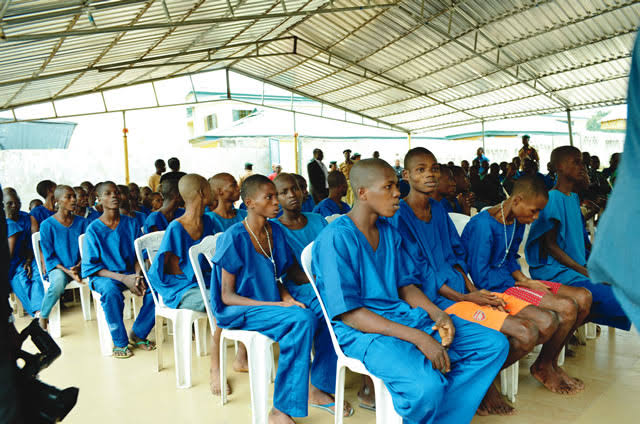
Nigerian Correctional Service, NCoS, has blamed the detention of minors in adult custodial centres on systemic failure at the state level, including the collapse of juvenile remand homes across the country.
Head of the Welfare Department, NCoS, Timothy Dabit, disclosed this Monday in Abuja, during the third public hearing of the Independent Investigative Panel on Alleged Corruption, Abuse of Power, Torture and Other Inhumane Treatment by NCoS.
The News Agency of Nigeria, NAN, reports that the panel was set up by the Minister of Interior, Dr Olubunmi Tunji-Ojo and chaired by the Permanent Secretary in the ministry, Dr Magdalene Ajani.
Other members of the panel are the executive director, Prisoners Rehabilitation and Welfare Action, PRAWA, who will serve as the secretary of the panel, Consultant Iyke of Brekete Family, among others.
Dabit said the presence of underage detainees in adult correctional facilities often stems from situations where children were brought in with warrants from the police.
“Sometimes a child arrives with a warrant and we are obliged to admit them based on that document as it contains details about the child.
“But when such a child is sent to an adult correctional centre, we question the police about the reason, which degenerates to a matter of contention, hence relying on them to justify the decision,” he said.
Dabit pointed out that one of the main reasons that minors are admitted to adult facilities is the absence of functional juvenile institutions close to the place of arrest.
According to him, currently, only three of such facilities in Kaduna, Ilorin and Abeokuta are operational.
“Geographical constraints and lack of facilities force officials to keep minors in inappropriate environments,” he said.
The NCoS official added that overcrowding is also a problem, with the capacity of Kaduna borstal pegged at 288 inmates, Ilorin at 250 and Abeokuta at 250.
He, however, said due to the shortage of institutions, there is overcapacity in most cases, except at Ilorin.
He disclosed that of the three, only Abeokuta is currently functioning for remand purpose.
“If you go to Ilorin, you will not find inmates or those awaiting trial. So, it is only Abeokuta that is requisitioned for that duty,” he said.
Dabit stressed that establishing remand homes is constitutionally the duty of governors.
According to him, in the past, almost all the governors had functional remand homes. Unfortunately, as we speak, most of them are no longer operational.
He, however, urged the investigative panel to help persuade state governments to restore remand facilities so that minors could be placed in safer environments.
“This panel will do us a lot of good if we can get in contact with governors. Let them rejuvenate their remand homes so that young offenders can be put there in calm,” he appealed.
On the issue of pregnant women in custody, he dismissed claims that they became pregnant while in correctional facilities.
“Sometimes, pregnant women are brought to custodial centres. Nobody gets pregnant when they are in the custodial centre.
“The woman is brought in, pregnancy test is conducted immediately. It is an emergency to ensure that the person is free,” Dabit explained.
The NCoS official also noted that personnel assigned to borstal institutions receive specialised training, wear distinctive uniforms and work alongside professionals.
This, he said, include psychologists to address the unique needs of minors in custody.
Despite NCoS’s explanation, representatives of the Nigerian Association of Clinical Psychologists and the Nigerian Psychological Association expressed concern over the treatment of minors and other vulnerable populations in correctional facilities.
Speaking on behalf of both associations, Dr Abigail Onu commended the panel for bringing national attention to systemic abuse.
She, however, condemned the continued detention of underage persons in adult prisons.
“We urge government to remove children under 18 from adult facilities, provide specialised care centres or approve orphanages with psychological and medical support,” she emphasised.
Onu stressed the long-term psychological harm such detention causes, citing the effects of Adverse Childhood Experiences.
She called for nationwide reforms including the recruitment of more psychologists, adoption of trauma-informed care and expansion of mental health services in the correctional system. NAN