…As intercity bus fares rise to 21.26% in September
By Yahaya Umar
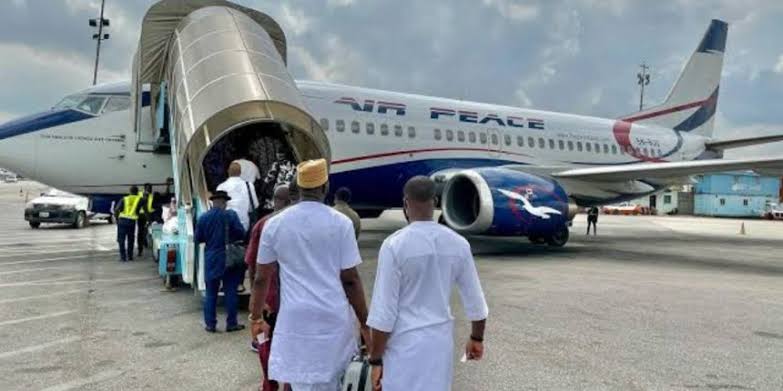
Average domestic airfare for a single journey on specified routes in Nigeria reached N124,693.40 in September 2024, reflecting a steep 57.81% increase from the N79,013.48 recorded in the same month last year.
On a month-to-month basis, fares saw a slight 0.80% uptick compared to August 2024, suggesting stability in price adjustments.
This data was obtained from the National Bureau of Statistics ,NBS, in its Transport Fare Watch for September 2024.
“In air travel, the average fare paid by air passengers for specified routes single journey was N124,693.40 in September 2024, showing an increase of 0.80% while compared to the previous month (August 2024). On a year-on-year basis, the fare rose by 57.81% from N79,013.48 in September 2023”, the NBS report stated in part.
The report emphasized an upward trend driven by increased demand and ongoing challenges, such as currency fluctuations and rising fuel prices. Seasonal variations and limited infrastructural upgrades further contributed to this surge in air travel costs across Nigeria.
The NBS report provided a detailed look into significant regional fare disparities in September 2024, showing that the Federal Capital Territory (Abuja) recorded the highest average airfare at N129,600.
Close contenders were Anambra, with fares averaging N129,045 and Oyo at N128,928. These higher costs in select regions may reflect demand patterns and varying operational costs for airlines, further emphasizing regional economic differences.
In contrast, Zamfara presented the lowest airfare average at N96,969, followed by Ekiti at N120,555.37 and Kano at N121,626.57. This wide range between the highest and lowest fares indicates not only the geographic variability but also highlights how the affordability of air travel varies significantly across states.
Regionally, the South-West geopolitical zone experienced the highest average airfare across all six zones, with prices reaching N126,013.30 in September 2024. This price represented a 1.81% month-on-month increase and a substantial 59.82% rise from September 2023 levels, aligning with trends in increased travel demands and inflationary impacts in the transportation sector.
Following closely, the South-East had an average fare of N125,881.64, marking a 60.95% year-on-year increase from N78,213.19 recorded in September 2023, along with a modest 0.19% monthly increase from August 2024. The rising prices here may correlate with a stronger demand for regional connectivity within and beyond Nigeria.
Meanwhile, the North-West zone recorded the lowest average airfare among the zones, with an average of N120,731.25 in September 2024.
in the same vein, Average fare paid by commuters for bus journeys between cities in September 2024 reached N7,175.06, indicating a slight increase of 0.22% compared to the previous month and a 21.26% rise compared to N5,917.16 recorded in September 2023.
This data was obtained from the Transport Fare Watch report for September 2024, released by the National Bureau of Statistics ,NBS.
“The average fare paid by commuters for intercity bus journeys per drop was N7,175.06 in September 2024, indicating an increase of 0.22% on a month-on-month basis compared to N7,159.00 in August 2024. On a year-on-year basis, the fare rose by 21.26% from N5,917.16 in September 2023″, the NBS report stated in part.
The report further revealed that Anambra State recorded the highest intercity bus travel fare (state route charged per person) in September, with N9,587.27, followed by Gombe at N8,330.05.
The lowest fare was recorded in Kwara at N5,579.42, followed by Ebonyi at N5,611.06.
On the regional front, the South-South zone had the highest average fare at N7,673.87, followed by the South-East with N7,351.05, while the North-Central zone recorded the lowest fare at N6,886.06.
The average fare for intra-city bus journeys rose by 3.45% from August, reflecting a year-on-year decline of 32.38%.
In air travel, fares increased by 0.80% from the previous month and showed a significant year-on-year rise of 57.81%.
For motorcycle (Okada) transportation, the average fare increased by 1.48% month-on-month but decreased by 26.04% compared to September 2023.
Water transport fares also saw a 1.30% monthly increase, with a year-on-year rise of 4.36%.
For intra-city bus journeys, Zamfara had the highest fare, while Adamawa recorded the lowest.
The highest motorcycle transport fare was noted in Lagos at N927.07, with the least in Anambra at N318.95. Water transport fares were highest in Bayelsa with an average of N4,573.16 and lowest in Borno at N471.01.
Zone analysis revealed that the South-West had the highest fares for intra-city bus journeys and air transportation, while the South-East recorded the lowest in intra-city bus fares.
For motorcycle fares, the South-West also led, while the South-East had the lowest. The South-South zone had the highest water transport fare, followed by the South-West, while the North-East had the least
Following the removal of fuel subsidies by the current administration in May 2023, transportation costs in Nigeria have surged significantly. In August 2024, the price of Premium Motor Spirit ,PMS, commonly known as petrol, rose sharply from N770.54 in July to N830.46, as reported by the National Bureau of Statistics ,NBS.
This represents a month-on-month increase of 7.78%, coinciding with the Nigerian National Petroleum Corporation ,NNPCL, acknowledgement of a substantial $6 million debt in subsidies. Year-on-year, the price of petrol has climbed by 32.51%, up from N626.70 during the same period last year to N830.46 this year.
In response to these escalating costs, the federal government has intensified efforts to promote Compressed Natural Gas ,CNG, as a more affordable alternative to petrol and diesel. To facilitate this transition, the Federal Government has launched its CNG Conversion Incentive Program in eight states, with plans to expand to nine additional states by the end of 2024.
The states currently participating include Oyo, Lagos, Ogun, Edo, Delta, Kogi, the Federal Capital Territory and Nasarawa. In Lagos, commercial vehicle owners can benefit from free CNG conversions at six approved centers under the Presidential Compressed Natural Gas Initiative ,PCNGi.